

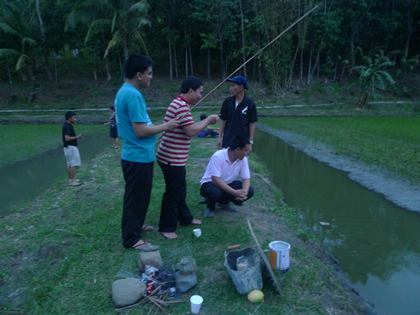
Goducate Training Center (GTC) in Iloilo, Philippines, trains community development workers (CDWs) for Asia. Since most needy Asian communities are rural agricultural communities, a large part of GTC is devoted to agriculture. Several new farming technologies are tested in GTC. Such testing provides the trainees with hands-on farming experience and develops in them the spirit of creativity and inquiry. One of the new farming methods in GTC is integrated rice-fish cultivation.
GTC’s rice-fields have consistently produced organic, high-yielding, high-quality rice three times per year. This rice should be sufficient to feed over 100 full-time trainees and staff throughout the year. Late last year, 2 plots of rice were “re-engineered” to cultivate both rice and fish. Instead of growing rice on the entire plot, the rim of the plot was dug out for fish cultivation. Tilapia and cat-fish fingerlings were put into the water.
The fish eat the insects that gather at the base of the rice stalks and the droppings of the fish fertilize the rice. This is important because GTC rice is produced without the use of insecticides and pesticides. The sale-price of fish is several times higher than that of rice and therefore raises the productivity of the plot.
This month we harvested the fish from one of the plots of rice. The harvest of tilapias and catfish were only 80 g (below the 100-plus kg that we had expected), and the size of many of the fish were below marketable size.
Obviously, there is much fine-tuning to do before we can confidently promote this form of farming to needy farmers to help them help themselves.

