

It’s been nearly a year since the extended Goducate Model Farm in Laguna went into operation. The aim of the model farm is to train community workers in organic ways of planting vegetables, in various forms of crop production, such as container gardening and hydroponics, in various forms of composting, and in farm management. These workers would then be able to help needy communities produce their own crops.
From about mid-year, there has been a series of harvests of the range of vegetables grown at the farm, as well as of papayas and bananas. What is not used for feeding the staff and for Goducate’s feeding program in the community has been sold either locally or in Manila. Staff enjoy some profit-sharing, and the rest of the income goes towards covering the expenses of the farm.


The Goducate Model Farm also serves as a place of training and of employment of some out-of-school youth. Two who are employed as cleaners are being trained in vermicomposting, and they have benefited from profit-sharing from sales of the vermicompost. Two others have been working part-time, while waiting to take up a course in technical work for TESDA (the Philippines Technical Education and Skills Development Authority) qualifications. 15-20 school-going children also help out at the farm, to earn some money for their schooling or to contribute to their families’ income.
From the start, the Goducate Model Farm has encouraged individual families to grow vegetables in their backyard for their own consumption (in Goducate’s veg@table project). This project was started in Dayap, a relocation village from victims in Manila of the 2009 Typhoon Ondoy. It has not been well taken up largely because of lack of running water in that village.
A few weeks ago another farming project was started in Blu-Paong, a small village where the majority of people are
unemployed. Instead of farming in individual backyards, Goducate is helping the villagers to set up a communal farm, a small replica of the Goducate farm, to give the community food for their own consumption as well as a means of livelihood.
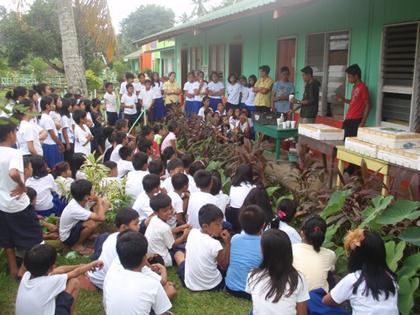
The training that staff from the Goducate Model Farm extends also to schools. Recently, they were at an elementary school in Tranca, to teach farming methods to the students and teachers.
Several of Goducate workers and volunteers are now at the Goducate Training Center in Iloilo being trained to be community development workers. When they return, the model farm should be able to extend its work more widely into the community.