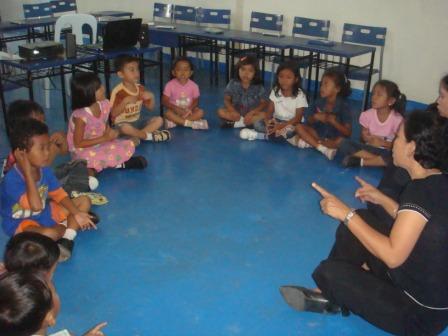
In January this year a Goducate friend started an informal English class in Batam, Indonesia. The class was held at the house of another friend, and it taught conversational English to 8-12 year olds.
During the course of these classes, some of the parents suggested that they would like a kindergarten. They belong to a poor community, many of whom came from other parts of Indonesia to seek work in Batam, and are unable to afford to send their children to kindergartens. Hence Goducate agreed to set up a kindergarten that would provide quality but affordable education for their children. The kindergarten was opened in July, and before we knew it, the class was full, and we had to turn away applicants.
A kindergarten class in sessionThe area in which the kindergarten students live
A team of administrators and trainers from the Goducate Training Center (GTC), Iloilo, The Philippines, went to Sabah last month on a vision trip. Much had been heard about the Goducate work in Sabah, but so much more was seen.
The first kampong (village) that the GTC team visited was so obscure that it’s hard to believe a community lives there. The hike was challenging, but nonetheless the trip was fulfilling when we reached the Goducate Literacy Center there and interacted with the people. Since we went with the local Goducate health educator, and since two of our team had been trained as nurses, simple medical services were given. Many of the adults there are hypertensive, probably because of their high-salt diet. One teammate encouraged the people to eat raw Malunggay (moringa) leaves, which are very rich in nutrients. When she demonstrated to them how do-able it is, the look on their faces was something to behold.
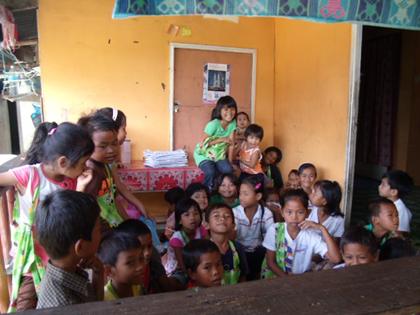
More and more kampongs were visited, and the general impression that the team had was that all the pupils were so eager to learn. For these underprivileged children, learning is so valuable that even without tables and chairs and with very minimal space, they are happy to cram into a shanty that serves as classroom. The students were confident when they stood up to greet us with their “Good Morning Sir.. Good Morning Mam”. Their situation in life didn’t deter them from believing in themselves and having an appropriate self-concept. A big factor, I believe, is our literacy program. Knowing how to read, write, count, and speak English has done so much to boost their morale. Many of those who have already graduated from the program have chosen to remain and be volunteer teachers. That way they continue their learning, help the younger ones, and earn money at the same time.
Our team did not let pass the chance of conducting a one-day seminar. Around 35 teachers were gathered from the various literacy centers. Team-building games and activities were introduced for the teachers to use in their classes, as were songs about maths and science. The teachers participated very enthusiastically. Everyone also gave full attention to the inspiring lecture on “Attitude” and interacted with the speaker. A special session on personality development was given to the group of young teachers after the seminar.
This Sabah trip was an eye-opening experience. It introduced the GTC team to a population of needy people in Asia they were unfamiliar with. It will certainly help the GTC staff to tailor their training for those trainees who might be selected to help out in Sabah.
Hike…..Pupils …….Team-building……..
Guest writer Bel, Staff from Goducate Training Center
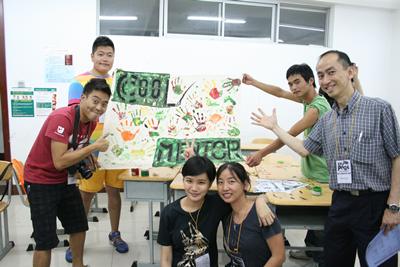
The Leadership Camp organized by Lifepegs in Changchun, China, gave more than 60 Chinese university students a week-long opportunity to learn about international leadership from a group of Singaporean and American teachers, with the help of the Lifepegs program team.
Students were introduced to four laws of leadership through lecture and discussion. These laws were: (1) The Law of the Lid, ( 2) The Law of Influence, (3) The Law of Solid Ground, and (4) The Law of Process. Students were given opportunities to put what they learned into action by taking part in team challenges. Some of these challenges included “Bigger and Better”, whereby teams were given Singaporean money and tried to exchange it for things of higher value by talking to store owners or people on the street. Other challenges were a type of scavenger-hunt race with checkpoints and opportunities for teams to work together and, as the finale, a very strategic game of Capture the Flag.
A group with the team flag that they had designedA team (in red) with their counsellors (in black) taking part in a raceA jubilant team in the Capture the Flag game.
The last night of camp was spent at a local deer farm. Students enjoyed barbecuing supper over an open fire, talking and singing around a bonfire, and sleeping in tents. Many of these students had never experienced camping in nature before.
Most of the students had not previously thought about or learned about leadership in such a structured manner. Whilst many students agreed with the laws of leadership as presented, some asked questions about the cultural significance of these laws and how to implement the laws into their daily lives as students and as soon-to-be professionals. At the end of camp, students were given feedback from their international counselors as to their strengths and weaknesses in leadership as observed throughout the week. One foundational concept that many of the students grasped was the importance of continually developing their leadership skills.
The Leadership Camp provided a great opportunity for students to meet new friends, to have fun, and, most importantly, to learn more about their current leadership styles and how to become better leaders.