Goducate makes a recce trip to typhoon-hit Compostela Valley

In the latter part of last year the Goducate team in Laguna helped the victims of Typhoon Hagabat, which hit Bay, in our own province of Laguna in August, by training them in livelihood skills—the men in agricultural techniques and the women in soapmaking and other handicraft.

In December 2012 Typhoon Bopha (a “supertyphoon” known locally as Typhoon Pablo) hit the southern Philippines. It was the strongest ever typhoon to hit the region, causing about a1000 deaths and many hundreds (about half of them fishermen) to go missing. Because of our experience helping the victims of Typhoon Hagabat, and because we had contacts in Compostela Valley, one of the provinces hit, we decided to explore the possibility of whether Goducate could help the people there.

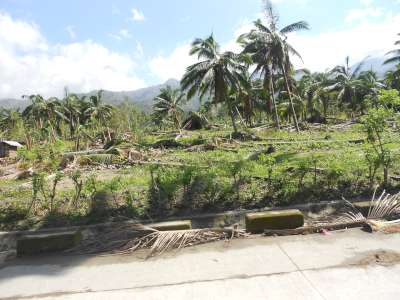
Our first action during our trip early this month was to drop off emergency supplies with our friends, for them to distribute through their organizations. Then we set off to visit the area worst affected. This used to be a village with around 100 houses, but we found only one house and half a church standing. We also saw badly damaged coconut and banana plantations. It could take 8 months to a year for a banana plant to recover and produce a harvest. For coconuts, the time could be 5 years.

We also visited a small home enterprise that, if scaled up, could provide jobs to many people.

Overall, there is a likelihood that Goducate could train the victims of Compostela Valley to help themselves. We are now mulling over plans as to how we can proceed.

Emergency relief supplies being downloaded.
The only house still standing
Damage to coconut plantation

Goducate Model Farm helps the community

It’s been nearly a year since the extended Goducate Model Farm in Laguna went into operation. The aim of the model farm is to train community workers in organic ways of planting vegetables, in various forms of crop production, such as container gardening and hydroponics, in various forms of composting, and in farm management. These workers would then be able to help needy communities produce their own crops.

From about mid-year, there has been a series of harvests of the range of vegetables grown at the farm, as well as of papayas and bananas. What is not used for feeding the staff and for Goducate’s feeding program in the community has been sold either locally or in Manila. Staff enjoy some profit-sharing, and the rest of the income goes towards covering the expenses of the farm.

Residents in Blu-Paong prepare beds for their crops
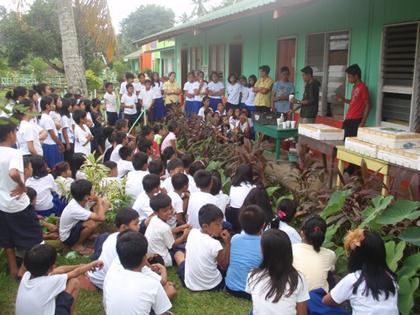
Students at Tranca Elementary School watch demonstration on planting
Students at Tranca Elementary School plant seedlings

The Goducate Model Farm also serves as a place of training and of employment of some out-of-school youth. Two who are employed as cleaners are being trained in vermicomposting, and they have benefited from profit-sharing from sales of the vermicompost. Two others have been working part-time, while waiting to take up a course in technical work for TESDA (the Philippines Technical Education and Skills Development Authority) qualifications. 15-20 school-going children also help out at the farm, to earn some money for their schooling or to contribute to their families’ income.

From the start, the Goducate Model Farm has encouraged individual families to grow vegetables in their backyard for their own consumption (in Goducate’s veg@table project). This project was started in Dayap, a relocation village from victims in Manila of the 2009 Typhoon Ondoy. It has not been well taken up largely because of lack of running water in that village.

A few weeks ago another farming project was started in Blu-Paong, a small village where the majority of people are
unemployed. Instead of farming in individual backyards, Goducate is helping the villagers to set up a communal farm, a small replica of the Goducate farm, to give the community food for their own consumption as well as a means of livelihood.

The training that staff from the Goducate Model Farm extends also to schools. Recently, they were at an elementary school in Tranca, to teach farming methods to the students and teachers.

Several of Goducate workers and volunteers are now at the Goducate Training Center in Iloilo being trained to be community development workers. When they return, the model farm should be able to extend its work more widely into the community.

Mothers learn to help at Goducate Literacy Centers in Philippines

Last month, when most of our volunteer teachers at the Goducate Literacy Centers in Laguna were sent to the Goducate Training Center in Iloilo to join the training for community development workers, our literacy centers were left with only one teacher each.

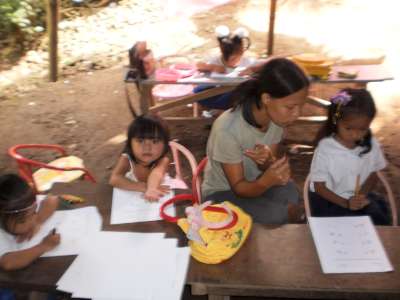
This was a bit tough for them— until they realised that some of the mothers were hanging around outside waiting for their kids, and that these mothers could be trained to help in the classroom. So our teachers encouraged them to take on some of the classroom responsibilities. After all, Goducate’s experience in Sabah, where mothers are trained to teach their children, has shown that such mothers make the most passionate and effective teachers.

Mother assisting in classroom
John David as teacher

Additional help is provided by Goducate college scholars, who volunteer their services. During their free periods. One example is John David, who had to drop out of college when he was a 3rd- year information-technology student because of his addiction to computer games. His parents refused to send him back to college.

However, when he was invited to join our 2nd Summer Music Workshop last year, he became so interested and learnt to play the viola well enough to earn a place back at college on a music scholarship. The scholarship covers his college fees. Goducate gives him an allowance to help with his other expenses. He now also helps teach at the Goducate Literacy Center at Ulik every Thursday, exemplifying how Goducate beneficiaries go on to help others.

Fathers in the community are also chipping in to help at the Goducate Literacy Centers. As in Sabah, they help largely with the construction of the Centers and with making the classroom furniture.

Fathers making desk