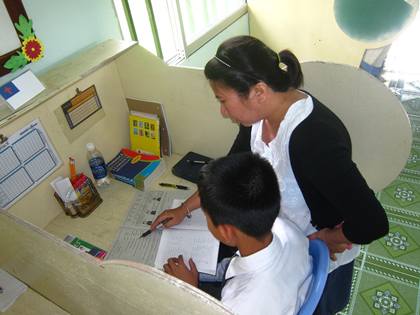
The Goducate Children’s Home in Cambodia expanded its staff strength recently with the arrival of three new Filipino staff members – teachers Sheila and Gene, and Will, an agriculturist.
The three arrived at the Home at the end of August. They had about a week to settle down before the start of the new academic year on 10th Sept. Sheila and Gene are trained in the US home based learning system which the children at the Home are enrolled in.
The start of a new academic year - at the schoolhouseGene at work
The main objective of my visit to the Goducate Children’s Home (GCH) in Cambodia was to highlight areas that could contribute to the attainment of food security at the Home. Since Goducate aims to help the needy help themselves, it follows that GCH should be as self-sufficient as possible.
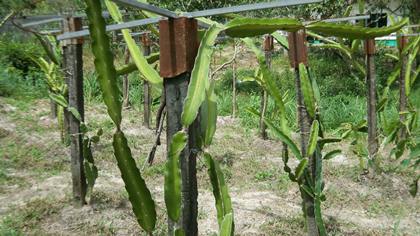
GCH is located 10 degrees north of the equator and sits about 15 meters above sea level. Its total land area is 66,851 sq m. Almost 45 % of the land has food-production potential and 25% is taken up by hardwood/pulp/fruit trees and other species endemic to the area. Small patches are grown with vegetables, corn, dragon fruit, pineapple, and dill.
80% of the land is level or gently sloping. The soil is predominantly sandy silt, highly alkaline, but suitable for fruit and timber trees. The highly porous soil lacks organic matter, which is essential for nutrient and moisture retention. Shallow-rooted plants, such as leafy, fruit, and root vegetables, are able to thrive but yield poorly because practically nothing is applied to improve the soil.
Lowland for conversion into rice production, duck raising, and. pangasius (catfish) culture
GCH has a bull and a heifer as well as seven goats, which graze on a free-range basis. No supplemental feeding is given for balanced nutrition. The poultry consists of 13 turkeys and 28 native chickens, which are also allowed to range freely.
For GCH to attain food security, it must focus on its comparative advantages. One area to consider is additional investments in goats and livestock. Forage grasses grow naturally in the area, so the cut-and-carry combined with forced feeding should be the production system of choice.
The very low organic matter content and fertility of the soil are good arguments for growing high-value vegetables through commercial hydroponics at GCH. In the medium-term, such constraint can be addressed by the application of vermicast and regular spraying of vermitea to the growing plants. This necessitates the sourcing of African Night Crawlers for vermicomposting. Morninga should be extensively planted to provide a source of nutritious Moringa-based foods and tea, and for animal feeds.
Also essential at GCH is a nursery for raising good-quality seedlings. The Home might even consider getting high-quality coffee and cacao seeds to turn the idle 1.15-hectare eastside idle space into an industrial plantation. The one-hectare remnant lowland, on the other hand, can be proportionately partitioned into parcels for rice production, duck raising, and catfish rearing.
Eroded soil with low organic matter content
The children at the GCH are already picking up agricultural and technical skills informally through their daily duties. A workshop has recently been built at GCH to train the children more systematically in technical skills. More systematic training in agricultural skills could also be considered. Two of the children from GCH are at present undergoing intensive training at the Goducate Training Center in Iloilo, The Philippines, to be community development workers. With good vocational training at GCH, more can be trained locally to be effective agents of change when they return to their respective communities.
Although a handful of the children at the Cambodian Children’s Home had picked up how to play a musical instrument, such as the guitar, the recorder, or the keyboard, it was only earlier this year that an intensive music program was introduced at the Home. Three of the musicians from the Goducate music program in the Philippines spent 10 days at the Cambodian Children’s Home giving intensive lessons in the recorder, keyboard, violin, and flute. Two months later, the children had a couple of days of violin and masterclass training from a visitor from Singapore before they performed at the opening of the boys’ workshop at the Home.
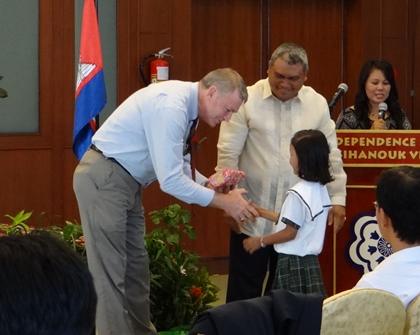
The end of the 2011-2012 school year presented another opportunity for the students to give a musical performance. This ceremony was much bigger and more formal than the opening of the workshop, and held away from the Home, so tension among the children was high, reaching a peak about an hour before the start of the ceremony. However, once they started on their performances they calmed down and played naturally, seemingly oblivious to what was going on around them.
Recorder playersStrings and wind playersKeyboard playerPresentation of award.