Classroom learning alone is insufficient for learning a language effectively. A person who depends on classroom learning only tends to speak very formally. To pick up the conversational form there is nothing like practicing with the locals.
A batch of Goducate community development workers who were trained at the Goducate Training Center in Iloilo, Philippines, are now at the Goducate Language Center in Batam learning Bahasa Indonesia (the Indonesian language) before they are sent out to work among the needy in Indonesia. To enable them to practice conversational Bahasa Indonesia, while at the same time doing community work, these language trainees visit an orphanage regularly.
This orphanage houses some 40 children ranging in age from 1 to 14. Each trainee has been assigned 5 of the children, to whom they act as older brothers or sisters. At each visit they play with their “siblings”, listen to their stories, and help them with homework.
Initially the trainees were scheduled to visit the orphanage for an hour once a week. Seeing how the children are so delighted by their visits, the trainees have squeezed time out of their busy schedule to visit the orphanage twice a week.
A trainee playing Snake and Ladders with older kidsTrainees teaching children origami
Guest writer Mel, Staff from Goducate Training Center
Batam is just an hour’s ferry ride from Singapore. From many parts of Batam, the sky-line of Singapore’s Central Business District can be seen quite clearly on a clear day.
Almost a million people live in Batam—the vast majority from other parts of Indonesia who come to look for employment in Batam’s many factories. When these people first arrive in Batam, the first challenge they encounter is to find an affordable place to stay in. Prices in Batam (especially housing prices) are about the highest in Indonesia because of the large numbers of Singaporeans who work and play there. So most newcomers end up staying in squatter areas where rentals are much cheaper.
Over a year ago, Goducate started weekend English classes in a squatter area in Batu Aji, Batam. Six months ago, we started a kindergarten for the children in that area. Last week we made a decision to expand the kindergarten to cope with the increased demand for spaces. Besides the much lower kindergarten fees, another reason for the demand is that we teach English to the children. This is unusual in Indonesia except in the high-end “international” kindergartens. In Goducate, we believe that the best time to learn a language is when children are young.
Last week our community development workers conducted a public health seminar for the mothers in the community. For most of the mums, it was the first time that they had attended a health seminar. Such education is especially important in a squatter area where toilets are “holes in the ground”, where water for washing is dirty and scarce, and where many of the children are under-nourished and prone to illnesses.
We have also purchased a piece of land in the “heart” of the squatter area to build a Goducate Community Center, where we hope to teach basic livelihood skills (eg, detergent making, welding).
We hope to transform this squatter area to a model community where needy Asians help themselves.
Squatter village in Batu AjiPublic health seminar held in Goducate KindergartenOn this land will rise Goducate Community Center!
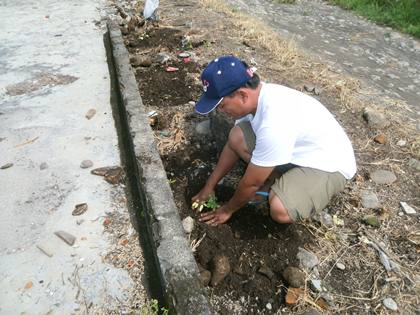
Come to Lau Ban-Ban in Binjai, North Sumatra, Kupang in East Timor, or Serpong Jakarta in Java and chances are you will find Daun Kelor or Merunggai in the backyard of some households. Scientifically known as Moringa olefeira, this miracle tree is extensively cultivated worldwide but is practically unknown to most Indonesians until its importance was recently highlighted to them by Goducate through theoretical and actual training.
Moringa is known for its edible leaves, flowers, fruits, roots, and seed oil, and has been traditionally used for herbal medicine to treat many ailments. These parts of the plant are rich in protein, minerals, beta-carotene, thiamin, riboflavin, and other vitamins, particularly vitamins A and C. The seeds contain 19- 47% oil and are rich in fatty acids (palmetic, stearic, behmic, and oleic acids) and can be used for human consumption, illumination, and cosmetics and soaps. The oil is also valued for its power of absorbing and retaining odors, and is used by watchmakers as lubricants. The roots are used as a condiment or garnish after they have been peeled, dried, and mixed with vinegar.
People with average health find a welcome boost of energy with moringa. Tests have shown that pregnant women who took moringa recovered faster from anemia and had babies with higher birth weights, while breast-feeding women had increased milk production with moringa. It can be used to cure cuts,scrapes, sores, and rashes, and can modulate the body’s defense system. Extracts from dry leaves, stem bark, and flowers can, respectively, heal ulcers, moderate high-blood pressure, and lower blood sugar, while the extract from dried powdered leaves has a very potent depressive effect on the central nervous system, resulting in significant muscle relaxation, decreased body temperature, and increased sleep time.
A small, fast-growing evergreen that reaches up to 12 m high, Moringa is characterized by its spreading, open crown of drooping, fragile branches, feathery foliage of tripinnate leaves, and thick, corky, whitish bark. It has been observed to tolerate temperature fluctuations from -1 to 48oC. It is drought tolerant and is known to thrive in places that have annual rainfall of as much as 1,800 mm. It grows well from sea level to 1,200 m elevation in most light- to medium-textured soils, but best growth occurs in sandy loams with a pH between 5.5 and 7.5. Propagation is also possible with cuttings, but studies show that trees propagated from seeds produce longer roots.
We hope that in the immediate term, more needy Indonesians would be inspired by Goducate to plant Moringa for fresh consumption and for processing into tea, micronutrient powder, probiotic capsule, juice, or energy drink, thereby improving their nutrition and health.
Lau Ban-Ban folks who attended the lecture on moringaLexon, a Goducate trained community development worker, shows proper mixing of soil medium for moringaTransplanting Moringa seedlings in Lau Ban-Ban