Goducate goes to Timor

Last week, a 6-men team from Goducate visited the capital of Nusa
Tenggara Timor (NTT) to do a survey trip. The team included Goducate’s Indonesian Coordinator (Thomos), our Agricultural Consultant (Ric Patricio), and 3 other Filipinos who are considering serving in Goducate Indonesia.

NTT is in Eastern Indonesia and is one of the poorer provinces of Indonesia. One of the major causes of the under-developed economy is the lack of rainfall. For about 6-8 months of each year there is hardly any rain. Furthermore, the soil is largely hilly and rocky.

In Kupang (the capital of NTT) we spoke at a seminar attended by 40 local community development workers who are working with poor children. I spoke on Goducate’s  philosophy of serving the poor and Ric spoke on the potential of promoting the moringa plant to alleviate the nutritional problems of poor children.

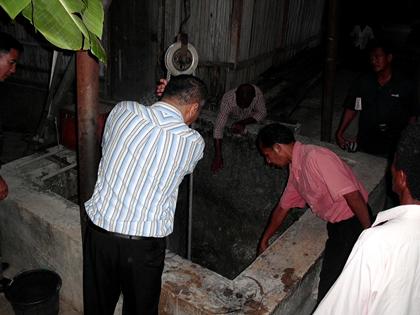
Looking at a precious source of water in arid Timor
Goducate team surveying a corn field

Moringa leaves gram for gram have 4 times the vitamin A of carrots, 7
times the vitamin C of oranges, 4 times the calcium of milk, and 2 times
the protein of milk. Besides these commonly known nutrients, moringa
leaves are also packed with a host of other micronutrients that are
often lacking in the diet of many poor children. The moringa plant can
grow in almost any type of soil (except water-logged soil) and
continues to grow even in long periods of drought. It is therefore
very suitable for NTT and in fact is found growing in many parts of
NTT.

When we did a survey of the community, we found out that the residents
were unaware of the benefits of moringa consumption and seldom ate it
(even if the plant grew in their backyard).

We will be collecting more data about the community’s attitude to consumption and gathering some samples of local moringa seeds for our agricultural experts to assess.

We look to the day when Goducate will be able to help the people of NTT to help themselves with a resource that will thrive in their own backyard.
Goducate Indonesia trains farmers on coffee technology

In the North Sumatran highlands, coffee is the main source of income for many households. Productivity is marginally low, however, so the majority of the farmers are unable to earn enough to improve their family’s welfare. The presence of unscrupulous traders worsens the situation, resulting in high indebtedness among the villagers and pushing them to be mired in a state of helplessness.

Senile coffee plants needing rejuvenation
Rejuvenated coffee plants that the farmers can expect to have a year and a half after pruning to rejuvenate the plants

A year ago, when Goducate Indonesia sent a team to do an agriculture survey, it found out that the coffee production practices were largely traditional in North Sumatra. Nursery activities and plantation management were below industry standards. Processing of coffee beans followed the dry rather than wet method. Without fermentation, which happens only with the wet scheme, proteolytic enzymes and good amino-acids remain unlocked within the beans, so the outcome is brewed coffee with inferior aroma and taste. The traders attributed these negatives to the coffee cultivar. Our team, however, pointed out to the farmers that they were, in fact, cultivating the best coffee in the world – Coffea arabica. This was observed to be the dominant variety in Tapanuli Region. Mandheling, its popular trade name, was derived from the name of the Mandailing Batak Tribe.

When the Dutch colonists established coffee plantations in the late eighteen hundreds, the cultivar they planted was C Arabica. They told the natives not to pick the cherries since drinking coffee was unhealthy. The oppression of villagers by corrupt and greedy officials is exposed in the book called “Max Havelaar and the Coffee Auctions of the Dutch Trading Company”.

In order to help the needy coffee growers help themselves, Goducate Indonesia initiated trainings on coffee technology in the villages of Sipultak and Sidikalang some months ago. 90% of the participants reported that it was the first time they were attending a lecture on coffee. The topics focused on plantation establishment basics (layout, staking, hole digging, refilling, basal application of organic fertilizer, planting, mulching, bending or stumping, sprout selection, training of verticals, desuckering, weeding, pruning, foliar fertilization, and pest control), methods of propagation, harvesting and processing, and rejuvenation or cutting of vertical stems of old trees to induce growth of new sprouts.

The trainings involved both lectures and demonstrations.  When we demonstrated the wet method of coffee processing to the farmers in Sipultak, and they realized after smelling the milled beans and tasting the brewed coffee how good their coffee was, they were so excited that we were unable to proceed with other topics that day.They were so challenged that they decided immediately to organize themselves into an association, which would help them in their negotiations with traders.

We hope that our initiatives will help the farmers to increase their coffee production and their productivity, to use their resources better, and to lead to more egalitarian income distribution among the coffee stakeholders.

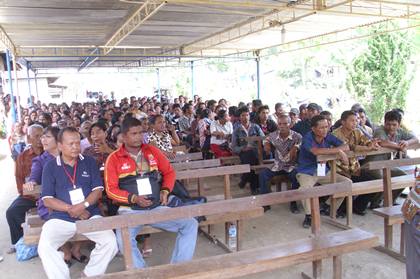
Sidikalang farmers attending training on coffee technology

Goducate Training Center staff learn from visit to North Sumatra

Three members of staff from the Goducate Training Center in Iloilo, Philippines, were recently in North Sumatra for an exposure trip. Jan, Jet, and Mike were there to learn from Goducate Indonesia, which has partnered with some organizations involved in poverty alleviation. This year, Goducate Indonesia has been in the forefront of helping transform the lives of disadvantaged Indonesians from a state of helplessness into a purposeful one.

In one village, the three observed that most of the people draw income from backyard animal raising, from crop sales, and from being hired workers. The household per capita income is below $800 per year, and the impoverishment is evident from their semi-permanent shelters with palm-frond roofing. The literacy level is low with no-one from among the 120 families in the community having a college degree.

Three months ago, Goducate Indonesia and its local partner conducted a consultation with the people, and the consensus was for a livestock project in the village. At the time the three men from the Goducate Training Center were there, the animal shed was being constructed, so, under my supervision (since I been through farm mechanics, carpentry, and farm structures classes in my days as an agricultural student), they were able to help install the electrical connections, the plumbing, and the electric water pump, thus saving the locals from having to seek expert help from elsewhere. They then showed the locals how to ferment feeds using indigenous materials mixed with proportionate amounts of water and molasses.
One other highlight of their visit was the trip to Nias Island. This is the largest island in a chain that parallels the west coast of North Sumatra. It has a population of about 800,000 people, most of whom are of Malay ancestry. In 2005, the coastal areas were devastated by a tsunami and more than 2,000 casualties were reported. The island used to be famous worldwide as surfing destination but the recent spates of earthquakes have considerably slowed down tourism.

In Nias, the Goducate Training Center staff helped me with my lectures on emerging agriculture technologies and in doing the field surveys. They noted that the islanders are very reliant on income from coconuts and native fruit trees as well as from sea resources. The techniques of food production used there, whether it be from poultry, livestock, vegetables, freshwater fish, grains, or cereals, is low tech, and the emphasis is in meeting the staple needs rather than for commercial scale.

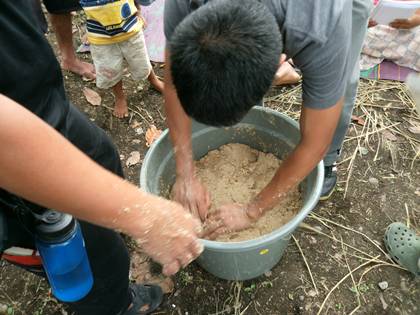
Demonstrating making of fermented feeds
Fixing the electrical line for a livestock project

The feedback from the three Goducate Training Center staff is vital for the enrichment of the existing curriculum at the training center. For instance, they found it worthwhile to include acquisition of basic skills in carpentry, plumbing, electricity, and rapid rural appraisal. These shared ideas will impact a lot on improving instruction so that the students will end up as holistically trained community development workers with the right mind-set of helping needy Asians help themselves.