De-worming for Goducate Center’s students.

One of Goducate’s learning centers in Sabah commemorated its first anniversary in an unusual way. The 60-plus students attending the two classes at this center underwent a de-worming session.

The teachers at our learning centers have observed that most of their children are malnourished, lethargic, and have a short attention span. These symptoms are very likely due to parasitic worm infestations and lack of a well-balanced diet.

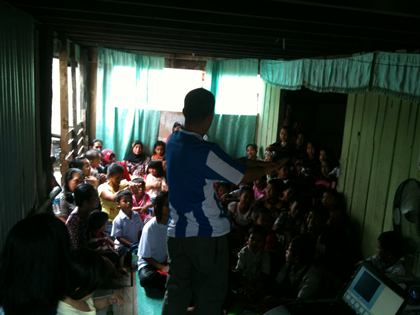
The event started with a health talk for both the children and their parents on parasitic worm diseases commonly seen in Southeast Asia. One of the contributing factors to parasitic worm infestation is that many of these kampong (village) kids grow up playing barefooted in the muddy soil below their houses, which are built on stilts above the mangrove swamps along the river banks or sea shores. Because of poor sanitation practice as well as poor hygienic practices, the soil becomes an excellent breeding ground for parasitic worms. As I spoke, I could see the parents nodding their heads in agreement with the various signs and symptoms I showed. Some of the parents could also share their own experiences of having parasites when they were young. I was happy to hear of their personal experiences because it will make it much easier for them to recognize and detect early parasitic worm infestation in their children. The kids expressed their dread of the outcome of parasitic infestations and couldn’t wait to learn how to avoid acquiring worms.

It was a good opportunity to reinforce the importance of observing personal hygiene, in particular through proper handwashing. During the handwashing demonstration, I was pleased to see so many of the parents actively going through the motions of the basic 7 steps of handwashing.

The session ended with distribution of deworming medication to all the students who were present that day. Goducate thanks the generous sponsors for the medical supplies and hopes to expand this de-worming program to the rest of our learning centers in Sabah the near future.

kids barefoot in the mud
Parents following good handwashing technique

Goducate staff will cross any bridge to train teachers

Goducate now has 17 learning centers in north east Sabah, manned by 34 teachers and 11 assistant teachers. Last month we were invited to two areas some distance away to train the people there to conduct our literacy programs. At the village 200 km away, we went to follow up on training that we did last year. At the village 400 km was new to us. I brought with me two of our teachers and an assistant teacher.

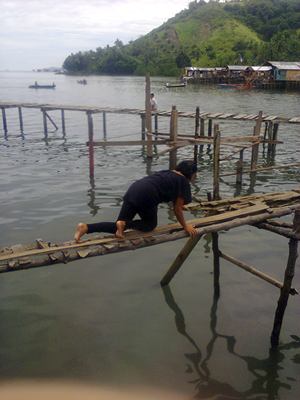
Safest way to cross a shaky jambatan
Goducate team with local partner (in the background)

Many of our villages are built on swampy land or over the water, so we are very used to shaky “jambatans” (bridges). But nothing prepared us for the shakiness and flimsiness of the jambatans we had to cross at the village 400 km away. These jambatans consisted of nothing more than pairs of thin planks held together by a few rusty nails. Worse, there were no bars, or poles, or ropes to hang on to for support. Some of us took off our footwear; another felt that the only way to maintain balance was to go on all fours. But all knew how important it was to get across the bridge, for waiting at the other end were people hungry for our help.

One of the locals participating in the training session; he was one of the two later appointed to be teachers

15 people attended our training session that day. From among them we selected one supervisor, two teachers, and two assistant teachers. We hope they will be able to use our program efficiently. For ourselves we hope to cross this bridge again, in follow-up training.


Goducate plans expansion of livelihood training in Sabah

Our Sabah Goducate literacy centers have produced over 2000 literate young people in the past 3 years. Many of our graduates have gone on to get jobs as waitresses, shop-assistants, receptionists, etc. These are jobs that were out of reach for them before Goducate came and taught them how to read, write, count, and speak English.

Last year, we started a livelihood center in our main schoolhouse. A sewing machine was bought, and girls were taught how to sew school satchels, pillow-cases, curtains, and a local dress (baju kurong). The project was a success from the very beginning.

Learning to sew
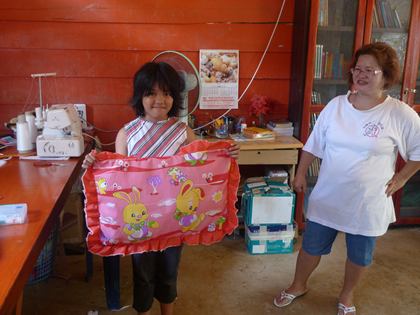
"This will sell for 4 Ringgit!"

Today, the center has 3 sewing-machines and an embroidery machine (that can do hemming and embroidery) and produces school-satchels for sale to our students, pillow-cases to the villages we serve, etc.

In a few weeks time, we will start teaching our students hair-cutting and other hair-dressing skills, One of our former teachers, who now works in a beauty saloon, will return as our instructress.

Next on the drawing-board is a welding workshop to teach young boys. This is a skill in high demand in the construction sties and the palm-oil plantations.