Students in Goducate Literacy Centers in Sabah get to know a world of competition

Goducate believes that learning should not be confined to the classroom. Here in the literacy centers in Sabah, despite our limited resources, skills, and manpower, we try our best to organize extra-curricular activities and competitions, to encourage the children to be active learners, to give the teachers the chance to enhance their creativity, and to build harmonious relationships with the local community.

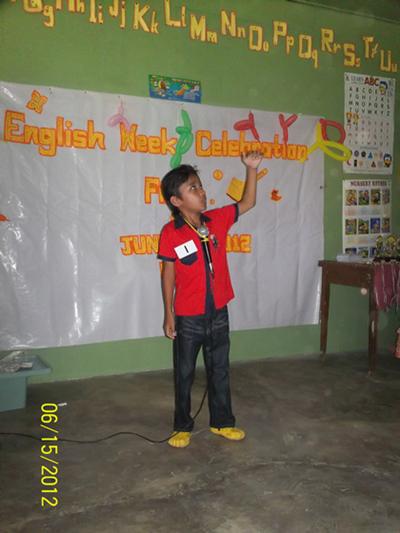
For our 2nd English Week Celebration each center was free to arrange itss own program of group and individual presentations, interpretative reading contests for intermediate level students, spelling contests for levels 2 and 3, and a poem contest for level 1. Some centers also included cultural and modern dances as their special intermission numbers. At every center, the whole community, especially the students’ parents and relatives, got involved.

Finalist in poem contest level 1

The plan to draw all the winners from each literacy center to compete for the finals at the main center probably contributed to the enthusiasm and excitement. But first we gathered all the teachers together to let them understand that the event should teach students and parents healthy competition and good sportsmanship.

What really amazed me most was to see the transformation in a little pupil, who during class would be sitting on the floor very quietly. During the competition, wearing shoes for the first time, he stood confidently and performed his best in front of many people. When he received much applause while holding a trophy and wearing a medal, I’m sure that this kid realized that there is a world outside his own village that he could enter and succeed in. This realization should help him to dream more and even to dream big.

Finals of spelling contest level 2
The judges

The world that lies ahead for this generation of children is likely to be more competitive than the one we are in today. The children being served by the Goducate literacy centers in Sabah are at a particular disadvantage because they do not have access to state education. We hope that the little that we can offer them will be able to give them a chance to compete in the outside world.
Goducate Training Center staff visit Sabah

A team of administrators and trainers from the Goducate Training Center (GTC), Iloilo, The Philippines, went to Sabah last month on a vision trip. Much had been heard about the Goducate work in Sabah, but so much more was seen.

The first kampong (village) that the GTC team visited was so obscure that it’s hard to believe a community lives there. The hike was challenging, but nonetheless the trip was fulfilling when we reached the Goducate Literacy Center there and interacted with the people. Since we went with the local Goducate health educator, and since two of our team had been trained as nurses, simple medical services were given. Many of the adults there are hypertensive, probably because of their high-salt diet. One teammate encouraged the people to eat raw Malunggay (moringa) leaves, which are very rich in nutrients. When she demonstrated to them how do-able it is, the look on their faces was something to behold.

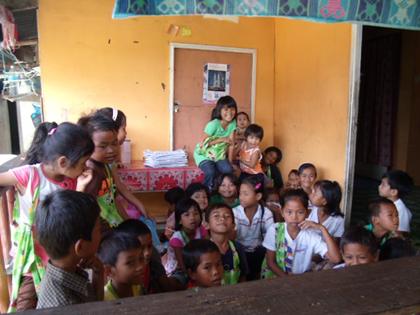
More and more kampongs were visited, and the general impression that the team had was that all the pupils were so eager to learn. For these underprivileged children, learning is so valuable that even without tables and chairs and with very minimal space, they are happy to cram into a shanty that serves as classroom. The students were confident when they stood up to greet us with their “Good Morning Sir.. Good Morning Mam”. Their situation in life didn’t deter them from believing in themselves and having an appropriate self-concept. A big factor, I believe, is our literacy program. Knowing how to read, write, count, and speak English has done so much to boost their morale. Many of those who have already graduated from the program have chosen to remain and be volunteer teachers. That way they continue their learning, help the younger ones, and earn money at the same time.
Our team did not let pass the chance of conducting a one-day seminar. Around 35 teachers were gathered from the various literacy centers. Team-building games and activities were introduced for the teachers to use in their classes, as were songs about maths and science. The teachers participated very enthusiastically. Everyone also gave full attention to the inspiring lecture on “Attitude” and interacted with the speaker. A special session on personality development was given to the group of young teachers after the seminar.

This Sabah trip was an eye-opening experience. It introduced the GTC team to a population of needy people in Asia they were unfamiliar with. It will certainly help the GTC staff to tailor their training for those trainees who might be selected to help out in Sabah.

Hike…..
Pupils …….
Team-building……..
Guest writer Bel, Staff from Goducate Training Center

Using technology for Goducate health program in Sabah

Goducate’s health program in Sabah is implemented by our local health educator. Since most of the community served by Goducate there do not have access to state health services, our health educator is often consulted about health problems. We have been exploring how to support her through a telehealth system that enables her to consult our registered nurse based in Singapore.

We initially tried live teleconsultation, but because of unreliable 3G connectivity in the field, it was not possible; however asynchronous teleconsultation was.

When our health educator is approached by a villager about a health problem, she will take measurements of some basic vital signs as well as record the villager’s medical concerns on a form that she will submit online to our nurse in Singapore. The clinical advice is then given in a form of skype chat/call to the relevant patient.

This online consultation does not cater for emergency situations, but rather for cases with chronic conditions. In the first two weeks of the trial, advice was given to 12 patients through this method.

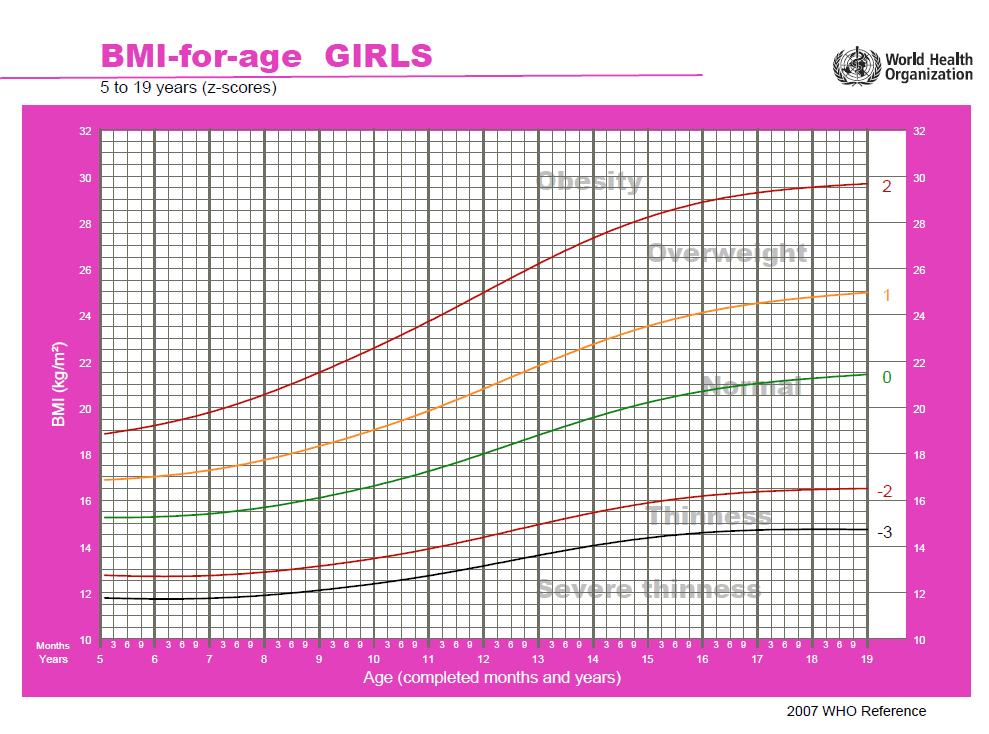
Another area in which we are trying to use free technological applications to help our health educator is in growth monitoring. Traditionally, health workers use the Age-BMI growth chart to plot measurements and detect a child who is malnourished or severely underweight.

Age-BMI for girls

Since this process is manual and can be very time consuming, and considering the vast number of students whose growth we are monitoring, a free application tool is used instead to obtain z scores (a measure of the degree of deviation from the mean) more quickly and accurately.

With this free application, known as Anthro Plus, our health educator needs only to input the student’s age, height and weight, and the software automatically calculates the z-score of the student.

Arthroplus z score

So far, these two technology tools have proven to be reliable and effective to keep the team in Singapore in touch with the team in Sabah.