Baa baa white bundles of joy at Goducate Training Center

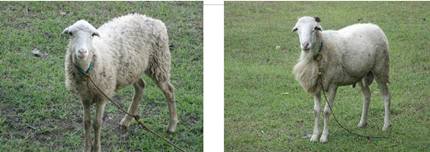
Six white bundles of joy arrived past midnight at the Goducate training center in San Miguel, Iloilo, The Philippines, a fortnight ago. The ram and five ewes are gifts to Goducate from Mr. Manny Delleva, a successful agri-entrepreneur from nearby Negros Island. They are hair sheep—ie, they grow more hair than wool, and are thus easier to take care of.

The ram is of Katahdin breed while the ewes are of St. Croix’s. The parental stocks were imported by Mr. Delleva from the US Virgin Islands in 2010. These sheep are excellent breeders. If allowed to fall in love unrestrained, each mature ewe can lamb twice a year with twins and occasional triplets and quadruplets. They have sweet faces and disposition, don’t jump on you, over you, or over the fence, and thus make excellent pets. They eat practically anything, even gmelina seeds, so they are excellent weed eaters and lawn mowers. They taste good and are an excellent source of lean organic meat. They adapt easily to tropical environment and are resistant to parasites and diseases common to small ruminants.

Eldest ewe (L) and ram (R) under restraint.
Being handfed seeds from Gmelina, a pulp tree endemic at the training center.

On their first day at the training center, the hierarchical “leadersheep” was immediately evident. The eldest ewe took charge and, being accustomed to range management, it led the flock in exploring the hillsides where they liberally took bites at whatever greens they found. A team of camp workers went after them, roped the leader, and towed it back. Sheep have a strong instinct to follow the one in front of them, so it was easy to bring back the rest of the flock into the open field. From then on, every day the eldest ewe has been harnessed by a rope secured to a stake to avoid a repeat of the “wandering” incident. The ram has also had to be restrained because it tends to take a secondary “leadersheep” role leading the younger ewes to the vegetable patch on taste-test sorties.
Pedro – life transformed by Goducate

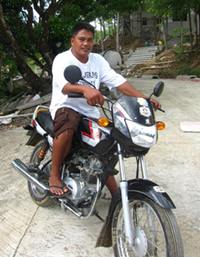
Pedro on his new motor-bike

Pedro, aged 32 and married with two young children, was a jobless and aimless fellow who first appeared at the Goducate Training Center (GTC) with his armed gang, hoping to extort some ‘protection money’ during the early stages of construction. Careful negotiations and counselling sessions with us subsequently led him out of the gang, and he joined the GTC construction team.

We also visited his family, showing them kindness and slowly helped them out of poverty. He owned no land or property, but we offered him opportunities at the GTC to learn farming. We shared our farming expertise with him and soon gave him charge of the hundreds of mango trees at the GTC.

Goducate’s philosophy of helping the poor to help themselves is seen in Pedro’s story – before long, he was able to repair his shack of a house, and subsequently bought a motor-bike, using it to visit other villagers in the area to teach them the farming and crop-growing skills he had picked up from the GTC.

Franklin – life transformed by Goducate

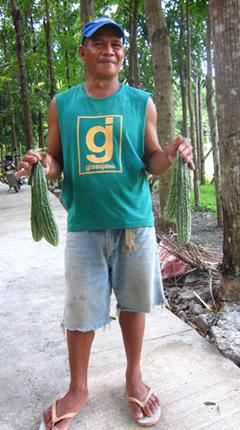
Franklin with his ampalaya harvest

When Franklin first came to Goducate, he was given the job of helping with the clearing of the jungle-like land which the Goducate Training Center (GTC) now stands on. After that, he continued to help us till the ground and grow useful plants and vegetables.

Now one of our hardworking, trusted workers, Franklin is married with one child. Although he owned a small piece of land not far away from the GTC, he could not afford seeds or fertilizer for planting. He and his family used to live very simply on one or two meals (rice and vegs only) a day. His desire to grow something on his land was soon realised when Goducate helped him with the initial investment of a few seeds.

After a few months, he has a thriving crop of ampalaya (bitter gourds) as well as hot peppers, pumpkins and rice on his own land. His family now has the means to add fish and meat regularly to their diet. At the GTC, he works tirelessly in the farms, regularly harvesting heaps of ampalaya, chilli and other vegetables for us.