Goducate soapmaking livelihood program in Laguna gets big break

Soapmaking was introduced into the Goducate livelihood program in Laguna, the Philippines, as a means for the women to earn some extra income for the family. Initially they made plain soaps and liquid detergent for personal use or for sale locally. More recently they were taught to make herbal soaps. And then they had a big break with an order for 400 pieces of herbal soap, from a couple getting married in Singapore and wanting to use the soaps as door gifts. The couple chose two kinds of soap—moringa and guava.

Moringa soap is made with extract from the leaves of the moringa plant. This plant contains many nutrients. Its leaves are rich in niacin, which as used in skin-care and anti-ageing products is said to promote skin health. Guava soap is made with extract from guava leaves, which are said to have antibacterial properties.

The team of 15 making or packaging these soaps was led by a Goducate supporter, an education graduate who had learnt about herbal soapmaking as a student while preparing for her thesis, and by a Goducate staff member overseeing livelihood projects. The soaps were wrapped with purple trimming, purple being the theme color for the wedding, and then placed in commercially bought abaca bags, which are made from the fibre obtained from the stalk of the abaca plant, a banana-like plant native to the Philippines.

We hope that this livelihood project will continue to be one that will benefit the needy being helped by Goducate.

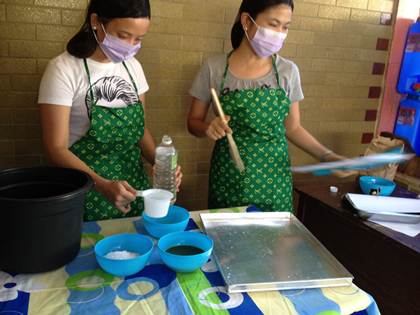
Nicky and Mechie Making the soap
Soap in its wrapping
Soaps in presentation bag

From the eyes of a first-time visitor to Goducate Laguna

Goducate Laguna has already 4 existing Literacy Centers. When we came last Nov 16, the latest center (in Ulik), which used to be under a temporary structure, was still being constructed by volunteers. We also visited the other centers and we met the teachers and workers in Sitio Lalao, Talahiban and Burol.

The literacy centers are small, but organized. Some of the workers were husband and wife teams. I could sense from within the four walls the love and care of the teachers towards the students. The children were much behaved.

Aside from the Literacy Center, the ministry in Talahiban also holds music classes, extension classes and livelihood programs. One mother showed to us the process of creatively turning scraps of perforated paper strips into cute give-aways and souvenir items.

We visited the mini training farm which was in the middle of a grassy field, surrounded by a few “named” cows. There were hydrophonics plants and the night crawler worms for the vermiculture process.

Our last stop was the Music Learning Center, which was in the second floor of a 3-storey building. Curtains were drawn to divide the classes. I wonder how can they not eaves-drop due to proximity.

All of these smooth visits on the same day had been possible because of the good weather, and thankfully, for Leo and hs wife, for their time and kindness. If time did permit, we could have been ferried to the flood-stricken area to visit the families whom Goducate had helped.

In my next visit, I desire to visit on dry lands again because, hopefully, the flood waters would have subsided by then.

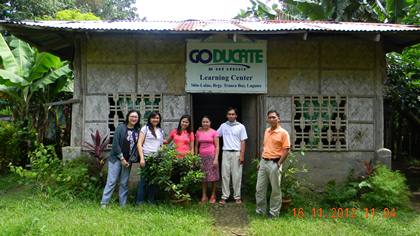
Visit to one of the Learning Centers in Laguna
livelihood training – making wedding souvenirs

Making decorative items is a Goducate livelihood program in Laguna

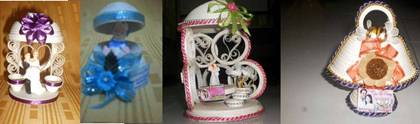
Goducate’s aim is to help the needy help themselves, not only by helping them through their schooling but also by offering them livelihood projects. Making decorative items out of rejects from paper factories is a Goducate livelihood program that has been started in Laguna.

A Goducate volunteer had learnt how to make these products from a friend who had attended a seminar on the technique. Initially this lady worked for her friend, but later decided to work with Goducate’s head of livelihood projects in Laguna to offer it as a livelihood project to parents of the children who attend Goducate Literacy Centers. Since the start of the program at one learning center in early October, the program has been extended to three other centers, with some 35 women taking part.

There are five basic designs in plain white that can be bought as they are. The women also produce decorated versions of these basic designs.

The women have been marketing their goods by personal visits to stores, and also online. A gift store in San Pablo City (a place where people go to buy such decorative items and souvenirs) has placed an order for 1000 items. Many have been bought as “giveaways” for weddings, and orders have been placed for several hundred pieces to be given away at two other weddings.

Scrap paper, the basic material
Part of the molding process
Samples of product