Women in Dayap learn to make soap

It’s the dry season in the Philippines in April and May, so it has been hard to keep the vegetable plots watered. Therefore those who have been taking part in our veg@table programme in Dayap are instead learning how to make liquid dishwashing soap from our livelihood trainer Jonatan.

Dayap is the resettlement village for people in Manila who lost their homes during Typhoon Ondoy in 2009. Most of the men still work in Manila in the week and come home only at the weekends. Hence it is the women who are around most of the time.

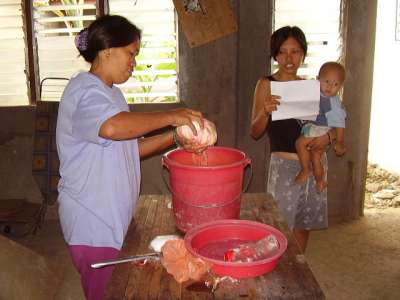
The two women in the accompanying photographs are already selling their soap. Goducate helped them with a loan of PHP 180 ($4) as start-up capital, which they will repay when they have sold all their products.

Jonatan teaching soapmaking
The first two candidates
The other learners

Goducate Orchestra Plays For Mayor

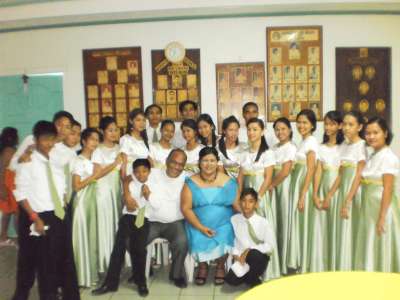
On March 19, the Goducate Orchestra provided the music at the birthday of the Mayor of Bay, Laguna, and the wedding of 64 couples. The Mayor had sponsored this mass wedding. That day was the day our orchestra wore the new uniforms that the Mayor had promised he would sponsor when we played for the town last December.

After the ceremony we were invited to join him for dinner at his office, where he shared with us that our playing for him made it one of his most memorable days. And as a birthday gift, we did not charge him for our services!

Goducate orchestra
Some of the 64 couples and their guests
Members of orchestra in their new uniforms with Mayor and his family

Goducate Training Center’s fish pond

On our recent trip to Goducate Training Center in Iloilo, Philippines we had the opportunity to catch the tilapia in our impounding lake.

The primary purpose of the impounding lake is to provide a source ofwater for our rice fields. Though there are 5 fresh-water springs on site, high-yielding rice requires lots of water to produce optimal yields.

Since the impounding lake is large (about half an acre) and deep (about 5 meters). we decided to stock it with fast-breeding fish. A local fish research institute gave us an hundred tilapia fingerlings a few months ago. Today, there are over 10,000 tilapia of various sizes.

Food to feed the tilapia is obtained from a local meat producer and bakery. Their “spoiled” meat and bakery items are fed to the tilapias.

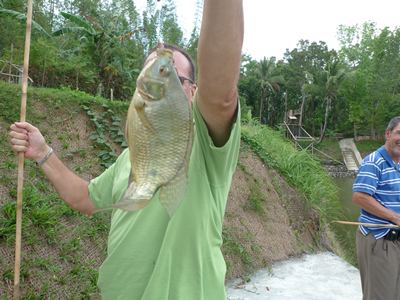
We were handed bamboo fishing rods and we began pulling tilapia out of the lake every minute. The little tilapias were thrown back into the lake and the large breeders were also thrown back.

A visitor to GTC fishing for tilapia
A visitor with his tilapia (this size of this fish is made much larger because it is held near the camera!)

These fish will be the main source of animal protein for the Goducate trainees when they begin their training at the end of April.


The Goducate trainees will also learn to breed tilapias so that they can help poor communities find another source of protein and income.