Goducate Training Center aims to be eco-friendly

The Goducate Training Center in San Miguuel, Iloilo, Philippines is nearing completion.

In line with Goducate’s philosophy of helping Asians help themselves, it aims to be eventually self-sustaining through the production of food for consumption and through revenue-generating activities that are in line with its philosophy of “education”.

GTC also aims to be eco-friendly.

Its slopes have been carefully terraced with sloping agricultural land technique (SALT) and planted to prevent erosion.

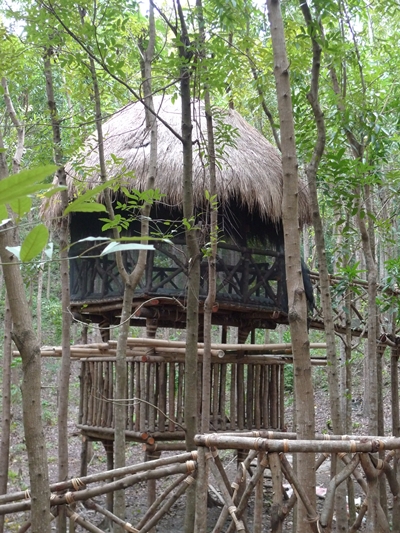
Many of its buildings are made of locally grown materials (mahogany and bamboo). The entire “Sky-City” of huts, walkways and toilet facilities is made of locally grown materials.

Sky-City hut made of mahogany, bamboo and dried grass
Sky-City "lobby" made of mahogany and bamboo

The restaurant and many other buildings are largely constructed of local materials. The lamp-posts are made from mahogany trees from our own forest. Even the structure for the zip-lines are made of locally grown mahogany lumber.

Water for the entire site is provided by 5 fresh-water springs and run-off water from the roof of the Multi-Purpose Hall. Some electricity is produced by a small hydro-electric generator that is propelled by run-off water from our impounding lake.

Horses will provide transportation on the site – instead of gas-guzzling and carbon-producing vehicles.

Pollution-free transportation that trims the grass and produces organic fertilizer

We hope that Goducate Training Center will train workers who can help the poor help themselves, without destroying the environment.

Goducate Training Center aims to be self-sustaining

The Goducate Training Center in San Miguel, Iloilo, Philippines, is fast taking shape.

The 11.2 hectare site has been transformed in the last 7 months from a forested area into a training center with agricultural fields (hybrid rice, vegetables, fruit trees), aquaculture pond (with over 3000 fish), large multipurpose hall (for training and accommodation), a camp-site (for accommodation) and recreational facilities (zip lines, horse trails, swimming/dipping pool, restaurant).

We hope to be able to take in our first batch of Goducate trainees in April. They will be trained to help poor communities of Asians help themselves. A large part of their training will be in agriculture and aquaculture so that they can help poor communities produce more food in a sustainable and eco-friendly way.

The trainees will support themselves during their 6-9 month training period by producing their own food – and in the process learn transferable agricultural and aqua-cultural skills.

They will also help to run the recreational and learning activities on the site to generate funds from corporations, educational institutions and other organizations. Presently, there is a strong demand for such activities (team-building, bonding, leadership) from such organizations in Iloilo. The funds generated from these activities will help Goducate Training Center to be self-sustaining in the near future.

This is in line with Goducate’s philosophy of helping others help themselves.
If we can’t help ourselves to be self-sustianing, then how can we help others do so?

Interior of Multi-Purpose Hall
Zip-line over Fish-pond with Restaurant in background
Main entrance
Spanish pony on play-field

Veg@table project gathers pace in Dayap

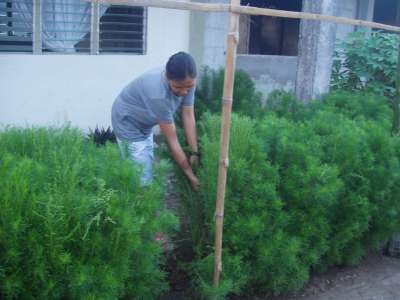
Grace pulling out her flowering plants to make way for beans

It takes only a spark to get a fire going. After seeing Nanay Anita’s vegetable plants in her frontyard starting to bear fruit, her neighbours want to turn their frontyards into vegetable patches too. One neighbour, Grace, a mother of 2, decided to pull out her flowering plants to grow beans instead. So far 14 families in Dayap have joined the project.

Grace pulling out her flowering plants to make way for beans

Jordan (left), the farm manager, with a father pleased with his tomato seedlings that have sprouted
Children planting seeds

The manager of our model farm, who is helping the community there to plant vegetables, recalls how the children used to have little better to do than throw stones at passersby, himself included. Now they want to help with the planting.