Mothers learn to help at Goducate Literacy Centers in Philippines

Last month, when most of our volunteer teachers at the Goducate Literacy Centers in Laguna were sent to the Goducate Training Center in Iloilo to join the training for community development workers, our literacy centers were left with only one teacher each.

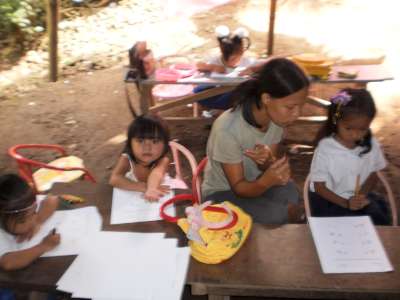
This was a bit tough for them— until they realised that some of the mothers were hanging around outside waiting for their kids, and that these mothers could be trained to help in the classroom. So our teachers encouraged them to take on some of the classroom responsibilities. After all, Goducate’s experience in Sabah, where mothers are trained to teach their children, has shown that such mothers make the most passionate and effective teachers.

Mother assisting in classroom
John David as teacher

Additional help is provided by Goducate college scholars, who volunteer their services. During their free periods. One example is John David, who had to drop out of college when he was a 3rd- year information-technology student because of his addiction to computer games. His parents refused to send him back to college.

However, when he was invited to join our 2nd Summer Music Workshop last year, he became so interested and learnt to play the viola well enough to earn a place back at college on a music scholarship. The scholarship covers his college fees. Goducate gives him an allowance to help with his other expenses. He now also helps teach at the Goducate Literacy Center at Ulik every Thursday, exemplifying how Goducate beneficiaries go on to help others.

Fathers in the community are also chipping in to help at the Goducate Literacy Centers. As in Sabah, they help largely with the construction of the Centers and with making the classroom furniture.

Fathers making desk

Nutrition Day events in Goducate Literacy Centers encourage teamwork between students and parents

The Philippines Nutrition Day in July was observed not only by the Goducate Literacy Center in Lalao (Aug 3 blog) but also by the other Goducate Literacy Centers in Laguna province—namely, at Mabacan and Talahiban. The students at Mabacan were joined by those attending the newly opened centers at Ulik and Burol.

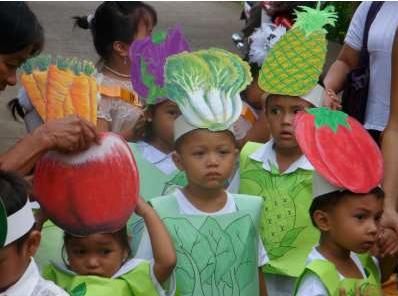
​All three centers followed a similar program that included, among other items, a parade of the students, accompanied by their parents and carrying baskets of fruit and vegetables, a competition among parent-child teams for the best slogan about vegetables, and a cookery contest for parents. At Mabacan, for instance, the winning slogan, was , “Kumain ng Gully para humaba ang iyong buhay” (“Always eat vegetables, so that your life will become longer”).

The idea of the Nutrition Day program was not just to teach children and their parents something about nutrition. It was also intended to encourage parents and their children to work together as a team. The Nutrition Day event is not the only one at which such teamwork is encouraged. Regular activities are held through the year to foster such cooperation.

Students at Mabacan with their veggie headgear
Performance by students at Talahiban
Students and mothers at Talahiban preparing posters of their slogans

GTC students prepare well for literacy teaching

Teaching literacy is likely to be one of the common tasks that Goducate’s community development workers will have to do when they finish their training and are sent to work among the needy. Even in places where the population is entitled to free state education, many children are unable to go to school, at least not regularly, because the family cannot afford the incidentals such as books, uniforms, or transport, or because the children have to be pulled out to help earn a living or look after younger sibs.

For their practical training in teaching literacy, students at the Goducate Training Center (GTC) in Iloilo go out into the neighbouring communities on Saturdays to conduct classes in literacy.

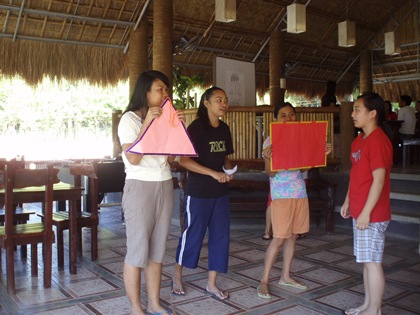
Practising using a game to teach shapes
Teaching through song

Recently I spent a couple of days at the Goducate Training Center and was impressed by how conscientiously and enthusiastically the trainees prepared for these sessions in the community. They are trained not to teach didactically. Instead, they spend much effort preparing how to capture their students’ interest and attention through creative visuals, songs, and games. Lunch breaks were used to prepare the visuals, and time was set aside to practise thoroughly how they would deliver their lessons. It was good to see them enjoying their practice. Their enthusiasm should rub off on their students.