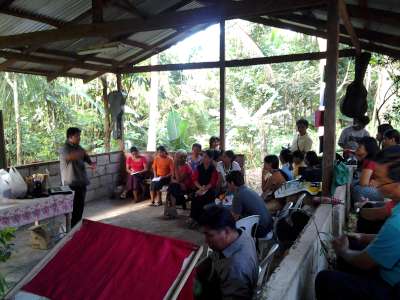
The livelihood program (SELP, Self Empowerment and Leadership Program) in Laguna recently held a session to upgrade soap-making skills, to teach perfume-making, and to motivate the members. It was attended by around 30 people, consisting of 9 leaders, 8 members, and the rest who were newcomers.
SELP covers 6 villages. Establishing the program has helped attract members by indicating to them that there will be continuing training.
The skills upgrading in soap-making was required because some of the members had found that the detergent they were producing was not producing much froth. We have also been able to find a new source of raw materials that enables the women to pool together to buy more cheaply in bulk.
Members sell their soap products by going house to house. On average, a woman sells about 10 kg soap powder and 5 litres of dishwashing liquid a week.
The most eagerly awaited item of the day’s session was the perfume-making. The expected market for the products would be high-school and college students.
Paying attention to speakerDemonstrating perfume-making
One way by which the Goducate Training Center in Iloilo, The Philippines, aims to work towards self-sustainability is to open its premises to visitors when the center is not in use for training. The restaurant is thus an important part of the center’s attractions. Hence I was invited to help widen the menu at the restaurant by teaching the cooks non-Filipino Asian dishes.
An important step in being able to produce an authentic national dish is to know what the real stuff tastes like, so the training for Bambi and Biboy started in Singapore and Malaysia. Their first week was spent tasting and tasting—well, eating and eating. On their arrival in Singapore earlier this month, we headed to Lai Lai Kitchen for a late lunch of some Taiwanese food of braised pork with rice and bubble tea. Bubble tea? What is that, Biboy asked?
The rest of the first week was food and more food in Singapore. The spread of the buffet at Buffet Town was eye-popping for them. There they sampled Western, Japanese, Chinese, and local foods. The selection of seafoods was Biboy’s favorite. Bambi was happy to be trying everything that came to the table. Biboy’s comment was that we must have eaten at least half a cow that night.
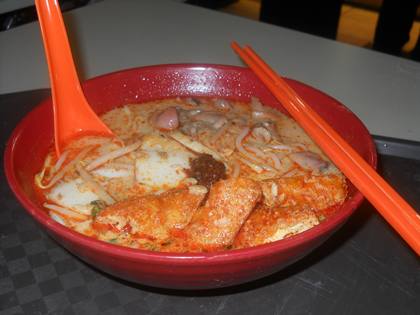
Biboy tucking into a tray of hot-stone noodlesBowl of “laksa” (rice noodles, fish cake, and bean curd in spicy coconut gravy), the dish that Biboy would choose if he could have only one choice. Bambi’s choice was “kaya”, an egg and coconut spread.Biboy and Bambi at EcoGarden in Johor taking a break from food.
The second week took them to Johor for more food and a few cook-outs in my kitchen. There were the kaya and bread making sessions and a sweet and sour pork and yakatori cook out.
The foods they tasted during their fortnight here included prata, laksa, kaya toast, nasi lemak, prawn mee, a whole range of Chinese stir fried dishes, dim sum, roast duck, char siew, and a fish-soup hot-pot. It was definitely a big change from their norm of rice for breakfast, rice for lunch, and rice for dinner!
As to what they will offer at the Goducate Training Center restaurant, just wait and see.
Part two of their training will be held in January, when we will be cooking the dishes at the training center in Iloilo.
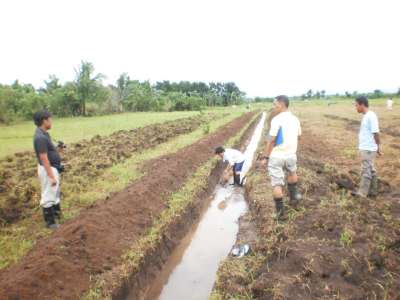
The Goducate Model Farm at Laguna has been a hive of activity, with staff and volunteers ploughing , weeding, and planting, and putting into practice all that was learnt during the 3-day training session by Ric Patricio and Vic de Paz from the Goducate Training Center in Iloilo.
The model farm was extended few months ago. An adjacent piece of land of 5000 sq m—ie, five times the size of the original farm—has been rented for 10 years.
2500 sq m have been allocated for sweet corn, 600 sq m for tomatoes, 600 sq m for bell peppers, and 1000 sq m for bitter gourds and string beans. The area between the drainage canals was planted with saplings of papaya alternating with lime, to prevent soil erosion.
Once the planting has been completed, work on container gardening and hydroponics will start.
The hope is that harvesting can start in February.
Learning about drainage from Vicploughing the fieldAll hands on deck on the farm