Looking forward in 2013

Goducate has been growing “too fast.” This is a good problem that we need to address in 2013.

Existing projects are growing faster than we had anticipated. And new opportunities have arisen before we felt that we had stabilized our on-going projects.

We are now serving needy Asians in Philippines, Cambodia, China, Malaysia, Indonesia, and India. If all goes well, we will start in Myanmar by next month. Thereafter, there are exciting potential prospects for serving in Laos and Thailand.

The Goducate Training Center in Iloilo, Philippines, has trained about 50 community development workers (CDWs) in 2012, and almost every one of the graduates is serving in needy areas of Asia (Philippines, Cambodia, Indonesia, and China). More than half of our graduates are serving in Goducate projects, while the others are serving in their home-places.

The next intake starts their training in next month. We are hoping to take in another batch in June. We hope that 2013 will see 100 CDWs graduate in 2013.

The Goducate Language Center in Batam, Indonesia took in its first batch of about 20 students 2 months ago. Eight of the students are Filipino CDWs who recently graduated from Goducate Training Center. These CDWs are studying Bahasa Indonesia before they are sent out to various parts of Indonesia. The other students are Indonesians who are learning English so that they can help Indonesians to learn English or help the Filipino CDWs as interpreters.

I will be in Bandung, Indonesia, next week to look at a piece of land that has been donated to us for the building of Goducate Indonesia headquarters. We hope also to develop a Goducate model farm in Bandung so that we can expand our agricultural programs in Indonesia. The demand for agricultural assistance is huge in this large, fertile, and under-developed country.

In 2013, we also hope to expand an ‘iconic” Goducate program—the Sing Your English (SYE) program. SYE is designed by Goducate to help teach Asians to speak English by overcoming the twin obstacles that have hindered the learning of English— namely, that of boredom and fear. SYE uses custom-composed, catchy songs to help overcome these obstacles. The results of initial testing of SYE programs in a few Indonesian schools last year have been very encouraging. There is a long list of schools hoping to use SYE. However, we believe that further testing and fine-tuning needs to be done before we offer this program to hundreds of schools, first in Indonesia and then in other Asian
countries.

Goducate has several programs that have been successfully used in different parts of Asia (eg. music for the masses, livelihood skills training for women, backyard farming for semi-urban slums, sports as a livelihood). In 2013 we hope to fine-tune and package these programs so that they can be expanded to reach far more needy Asians.

Currently, Goducate headquarters in Singapore is run by volunteers who meet in premises belonging to a sponsor but work from home. In 2013, we hope to have our own office space, and some key paid staff to coordinate and expand our fast-growing work. This will be a paradigm shift from our “volunteers only” policy at headquarters since the founding of Goducate. However, this is another good “problem” that we have to face so that we can improve our organization and efficiency, to help more needy Asians help themselves.

Meeting room that sponsor shares with us
Entrance to shared premises

Goducate makes a recce trip to typhoon-hit Compostela Valley

In the latter part of last year the Goducate team in Laguna helped the victims of Typhoon Hagabat, which hit Bay, in our own province of Laguna in August, by training them in livelihood skills—the men in agricultural techniques and the women in soapmaking and other handicraft.

In December 2012 Typhoon Bopha (a “supertyphoon” known locally as Typhoon Pablo) hit the southern Philippines. It was the strongest ever typhoon to hit the region, causing about a1000 deaths and many hundreds (about half of them fishermen) to go missing. Because of our experience helping the victims of Typhoon Hagabat, and because we had contacts in Compostela Valley, one of the provinces hit, we decided to explore the possibility of whether Goducate could help the people there.

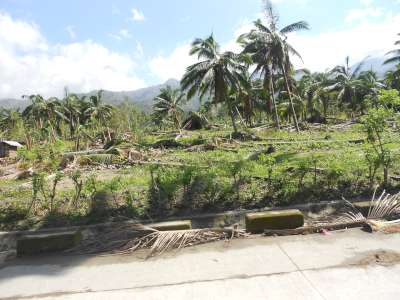
Our first action during our trip early this month was to drop off emergency supplies with our friends, for them to distribute through their organizations. Then we set off to visit the area worst affected. This used to be a village with around 100 houses, but we found only one house and half a church standing. We also saw badly damaged coconut and banana plantations. It could take 8 months to a year for a banana plant to recover and produce a harvest. For coconuts, the time could be 5 years.

We also visited a small home enterprise that, if scaled up, could provide jobs to many people.

Overall, there is a likelihood that Goducate could train the victims of Compostela Valley to help themselves. We are now mulling over plans as to how we can proceed.

Emergency relief supplies being downloaded.
The only house still standing
Damage to coconut plantation

Teachers in Goducate literacy centers in Sabah complete round of training

The mothers and young people in who teach at the Goducate literacy centers in Sabah believe in the principle that learning is a process. This gives them the encouragement never to stop learning. Hence every time a training schedule is announced everyone, whether older teacher or new one, is ready and excited.

We have a waiting list of invitations from villages requesting us to open learning centers for them. They were asked to identify individuals in their community able and willing to be trained as teachers. This recent round of training conducted during the second and third week of December and the first week of January was attended by 54 people—-44 existing and 10 potential teachers. The training was facilitated by our head trainer and some of our pioneer teachers, as well as by the visiting trainer from the Goducate Training Center in Iloilo, Philippines, who has been coming every year to help with the training. For the training sessions, the teachers were broken up by their level of knowledge and experience.

Our visiting trainer commented on the big improvements she has seen in the performance of the teachers through the years. With the training of the new teachers, we will be opening a few more centers soon. These new teachers will be assisted by the more experienced teachers from other centers until such time as they are fit and confident to teach on their own.

Although this round of training has just been completed, all the teachers know that there will be more to come. Training sessions are held every quarter. Goducate believes that it is important to maintain the quality of the teachers’ performance through regular training.

Trainees listening attentively
Pioneer teacher as trainer
New teacher demonstrating letter sounds