To get on in India today, one has to be a global citizen. With some 65% of companies here being international, and with Indians having to travel abroad for work or business, understanding other cultures and being able to speak English are important requisites for getting and holding on to a good job. Many students in India come from backgrounds that do not offer them these “qualifications”. Hence Goducate has set up a centre called Global Life Hub in Hyderabad to help the less advantaged university students learn to be global citizens.
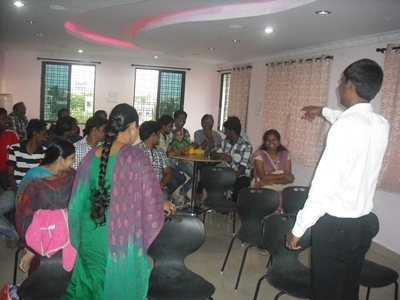
Listening to an introduction about the Global Life HubParticipating in an icebreaker gameRelaxing in the lounge area
The center was launched on Aug 11. It will be a place where students can meet foreigners, learn about other cultures, and practise their English so that they can converse in this fluently, naturally, and confidently.
Also, about twice a month we will invite professionals from multinational corporations to come to talk to the students about life in the corporate world and about the challenges they face daily in their office. In doing so we hope to give the students an idea about what they will be facing in global India.
Teaching literacy is likely to be one of the common tasks that Goducate’s community development workers will have to do when they finish their training and are sent to work among the needy. Even in places where the population is entitled to free state education, many children are unable to go to school, at least not regularly, because the family cannot afford the incidentals such as books, uniforms, or transport, or because the children have to be pulled out to help earn a living or look after younger sibs.
For their practical training in teaching literacy, students at the Goducate Training Center (GTC) in Iloilo go out into the neighbouring communities on Saturdays to conduct classes in literacy.
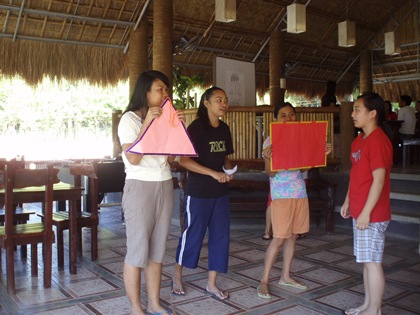
Practising using a game to teach shapesTeaching through song
Recently I spent a couple of days at the Goducate Training Center and was impressed by how conscientiously and enthusiastically the trainees prepared for these sessions in the community. They are trained not to teach didactically. Instead, they spend much effort preparing how to capture their students’ interest and attention through creative visuals, songs, and games. Lunch breaks were used to prepare the visuals, and time was set aside to practise thoroughly how they would deliver their lessons. It was good to see them enjoying their practice. Their enthusiasm should rub off on their students.
How time flies. Goducate’s first literacy center in Sabah celebrated its 4th anniversary last month. The day-long program included a variety of performances by different classes of songs, poems, and cultural and modern dances, a singing contest in which students and teachers participated (with teachers from other centers as judges), a beauty contest, and an afternoon packed with outdoor games (again with teachers and students participating). We were privileged to have a visitor from Singapore give an inspirational talk and be one of the judges.
Every year this center (the KSO center) has celebrated its anniversary without realizing its influence is on the other centers. At the time of KSO’s 4th anniversary, we had 25 Goducate Literacy Centers in Sabah. By now there are 27.
KSO is where many dreams have been moulded as both teachers and pupils have gained new perspectives on life. KSO has also been instrumental in the training of effective and efficient educators. It serves as a model center for the other Goducate centers.
Some 30 teachers have been through this center. Their contribution to the development and influence of KSO is immeasurable. Some of them have now taken on roles as trainers, supervisor, livelihood manager, and health worker. Some are still teaching in this center. Some are teaching in other centers. Many have to help out in newly opened centers. Some have found jobs (for example, as waitresses, hair stylists, housekeepers) but continue to teach some sessions at the literacy centers, in some cases literacy classes, in others livelihood training. Some have left the area, and have started literacy centers in their new locations. A few of them have been to other towns to help other organizations train their teachers.
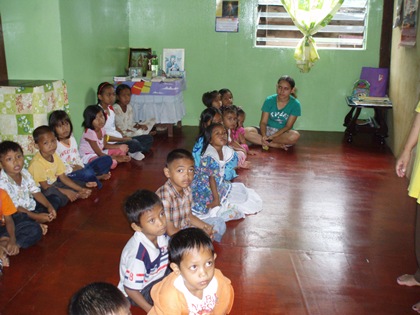
A classroom in the early days, in somebody's living roomThe library
When it comes to its facilities, this main center (or “mother-center”) has undergone many changes. At the start somebody’s living room was used as classroom. Then a one-classroom building was built. Now KSO has three classrooms (one of which is our audiovisual room) serving five teaching sessions a day. Two classrooms are used twice a day, and the audiovisual room once a day. There is also a livelihood-training area consisting of a mini-kitchen, a sewing area, and a hair salon. In addition KSO has a library and a playground, and it is the base of our mobile clinic.
KSO has reached this stage despite having to face many challenges, but these have led to a unity that has contributed to its development.