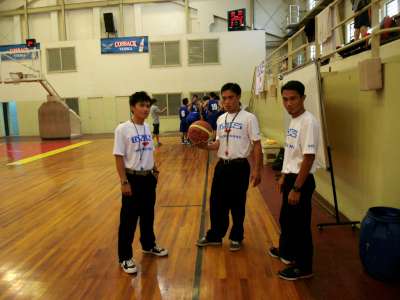
Five of the first batch of trainees who completed the Goducate training program for basketball officials did not have to wait long to get their first jobs. And the jobs were not for matches at village level (where they had done their training), but at inter-university level. This job opportunity for out-of-school youth arose with the 10-day visit of the Indonesian Youth Team from West Java to play against eight colleges and universities in The Philippines.
The three serving as referees earned PHP300 ($ 7) each per game, and the two who were table officials received PHP200 ($4.70) each. PHP 300 is considered the daily minimum wage at provincial level. For these boys, the sums represent a great deal. For instance, Jay-R, one of the referees, had to leave college 2 years ago because of financial difficulties. His income as referee is sufficient for his personal needs. Erwin, who was unable to complete high school, became a trouble-maker in his family, but now is a trained table official.
Our referees Jay-R, Stephen and JoyOur table officials Levi and ErwinStephen attending to an injury
Apart from the thrill of landing their first jobs, the boys had another memorable experience—their 10-day stay in a hotel was the first time they had slept in an air-conditioned room.
Our basketball training program is now being introduced in other villages. We hope that through it many out-of-school youth will be able to get back to schools or colleges through sports scholarships, or to be able to earn a living.
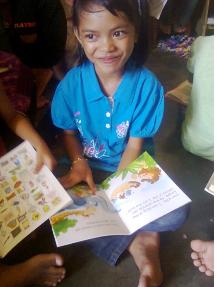
Goducate believes in encouraging the students at the literacy centers to read. However, it has not been easy to set up a library, or somewhere to store books securely. For one thing the centers are scattered over a wide area. For another, many centers are the living rooms of the locals into which the students squeeze for their lessons, while others are very basic structures consisting just of a roof and low walls. So for a long time the books the students had access to were what the teachers could carry around with them.
The joy of having a book to read.
This year we have managed to rent from the landowner of the first Goducate literacy center in Sabah the use of an adjacent garage, which we have split into two parts. One part houses the books for the students, the teaching resources (flash cards, text books), and reference material (dictionaries, encyclopedias, maps, various charts). The other part is the audiovisual section, which houses a television set, a DVD player, a laptop, board games, puzzles, and toys.
Children in the AV sectionExploring a world map for the first timeThe librarian
This main library is open through the week every morning and from 2-4 in the afternoons for those who live near enough to visit it. For 12 of the centers that are located too far away, a mobile library system has been set up. Every month a new set of 50 books is sent to each of these centers. The main library is also open, for a small fee, to those who are not students at the Goducate literacy centers. We hope that this library, which we refer to as “Uncle Tom’s Learning Center” after the benefactor who provided much of the resources for this place, will be a model for similar set-ups in other villages where Goducate operates. Meanwhile we will probably be setting up a similar facility next month for a plantation owner who would like one for his workers to use at night.
Teacher in charge of AV learning to use the laptop
Two of our teachers have been instrumental in the setting up and running of this library. One is in charge of the library section, and the other in charge of the audiovisual section. They have got all the teachers and many of the parents involved and have set up a card system for borrowing material.
Two weeks into their six-month training and the new batch of international students at the Goducate Training Center are all primed up to becoming effective community development workers in Asia. The course contents are quite diverse but the main emphasis is on teaching them how to teach needy Asians help themselves through practical but scientific technologies to produce safe and wholesome farm products. Through hands-on training, they will learn how to follow good agricultural practices to ensure social, economic, and environmental sustainability—knowledge that they should be able to pass on to farmers and members of their household.
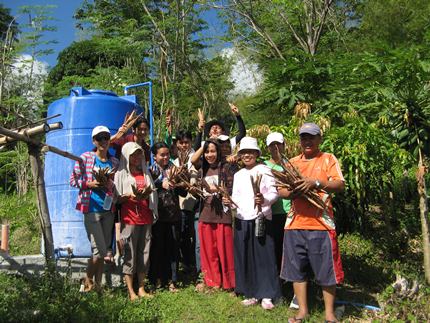
The diversity of the students goes beyond culture because they also vary in age, gender, and academic background. The common denominator, however, is their passion and eagerness to become effective change agents. Their first few days at GTC were spent on acclimatizing, bonding, getting acquainted with the faculty and staff, and learning the basics of various courses. For practicum, they had already been exposed to actual seed planting and harvesting of moringa pods, corn, rice, and fish.
Harvesting moringa pods the Indonesian, Malaysian, and Filipino waythe Cambodian wayStudents in the container garden with the corn they plucked
The following are impressions shared by some of the trainees:
“Before I thought that agriculture is boring but soon things turned 180 degrees for me. I learned to appreciate and love it. I was amazed to learn that plants can be successfully grown in nutrient-rich water. And to pluck a corn cob from its stalk for the first time ever? Simply amazing! I’m so excited to learn more .” —Jean, Malaysia
“I am very thankful to all my sponsors for enabling me to study at GTC to learn many things especially about agriculture. Coming from a children’s home and to another country for the first time, I am overwhelmed by the new and rich experiences. Surely I will have a lot to share with my own people after completing my study here.”—Nathan, Cambodia
“It’s a great privilege to be at GTC. In the beginning I thought agriculture is very boring but during the lecture on recent trends that included tissue culture, biotechnology, hydroponics, bubbleponics, aeroponics, and aquaponic, my interest on these things went up several notches. Now I am an eager student of agriculture.”—Lexon, Indonesia
“Magnificent. Intensive. Flexible. These are how I describe the place, training and fellow trainees. Magnificent in the sense that GTC is a venue where we can learn a lot of skills that can never be learned from a four-walled traditional classroom. Intensive because theory combined with hands-on are being taught by brilliant mentors and facilitators. Flexible as the six month-training is continually attuned with the absorptive capacity of its international students. As one of the future GTC-trained community development workers, I must therefore GO and EDUCATE!”—Nini, Philippines