Goducate’s integrated rice-fish cultivation needs fine-tuning

Goducate Training Center (GTC) in Iloilo, Philippines, trains community development workers (CDWs) for Asia. Since most needy Asian communities are rural agricultural communities, a large part of GTC is devoted to  agriculture. Several new farming technologies are tested in GTC. Such testing provides the trainees with hands-on farming experience and develops in them the spirit of creativity and inquiry. One of the new farming methods in GTC is integrated rice-fish cultivation.

GTC’s rice-fields have consistently produced organic, high-yielding, high-quality rice three times per year. This rice should be sufficient to feed over 100 full-time trainees and staff throughout the year. Late last year, 2 plots of rice were “re-engineered” to cultivate both rice and fish. Instead of growing rice on the entire plot, the rim of  the plot was dug out for fish cultivation. Tilapia and cat-fish fingerlings were put into the water.

The fish eat the insects that gather at the base of the rice stalks and the droppings of the fish fertilize the rice. This is important because GTC rice is produced without the use of insecticides and pesticides. The sale-price of fish is several times higher than that of rice and therefore raises the productivity of the plot.

This month we harvested the fish from one of the plots of rice. The harvest of tilapias and catfish were only 80 g (below the 100-plus kg that we had expected), and the size of many of the fish were below marketable size.

Obviously, there is much fine-tuning to do before we can confidently promote this form of farming to needy farmers to help them help themselves.


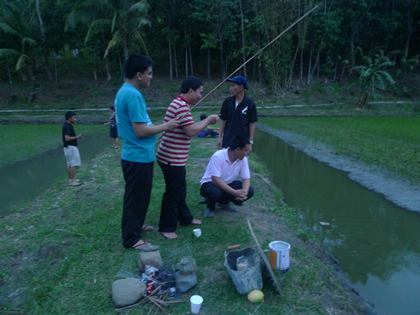
Having fun before the harvest (note the rim of water around the rice-field)
Harvested tilapias

Goducate starts a sports program

The Goducate Music Program in Laguna, The Philippines, has been very successful in getting Filipino youth off the streets and back to schools and colleges, in instilling in them discipline, and in giving them hope and a new sense of purpose. Many of our music students are also busy training subsequent batches of new students. Some of them are also earning income by performing at functions and by teaching in our new music studio. Five of them have been sent to Singapore and trained by a well-known music school, Wolfgang Violin Studio. One of them is presently being trained to be a teacher at Wolfgang Violin Studio.

Successful as this program is, it reaches only the more musically inclined sector of the population. A large number of youth, especially the males, are not inclined to be musicians. However, most of these are crazy about basketball. The Philippines is indeed a “basketball crazy nation”. Every little village has basketball hoops hanging from lamp-posts, and almost every town has its covered basketball court.

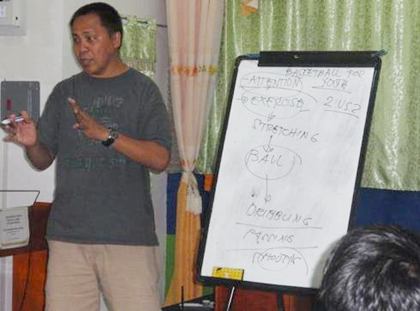
When Goducate saw the potential of using this basketball-mania to further its goal of “helping Asians help themselves”, it appointed a well-known Filipino basketball coach, David “Boycie” Zamar, as its Sports Director. Boycie has played professional basketball in The Philippines, has been trained in the USA, and has coached the Philippines youth team as well as teams in the Middle-East, Indonesia, Malaysia, and Singapore. He is one of only 5 FiBA-certified referees in The Philippines.

Boycie shares Goducate’s dream of using sports to teach useful life-skills such as discipline, endurance, team-work, obedience, and fair play. He also aims to see many of these youth get back to school and college—via sports scholarships. After barely a week with us, he managed to get one of the youth into a college sports program.

Discipline and hard work!


Coach Boycie


With the help of a friend who is a certified FiBA referee, he has organized training for referees. This will not only improve the quality of play by reducing the number of on-court fights, but will also provide the referees with a means of earning a living as referees for village games. (Referees are paid 300 pesos/game).

Goducate plans to include in the sports program other livelihood training.  For a start the basketballers will also be trained in skills such as welding (in The Philippines TESDA [Technical Education and Skills Development Authority] program) and agriculture (growing moringa as part of sports nutrition education). We are confident that this program will help Asians help themselves.

Goducate plans expansion of livelihood training in Sabah

Our Sabah Goducate literacy centers have produced over 2000 literate young people in the past 3 years. Many of our graduates have gone on to get jobs as waitresses, shop-assistants, receptionists, etc. These are jobs that were out of reach for them before Goducate came and taught them how to read, write, count, and speak English.

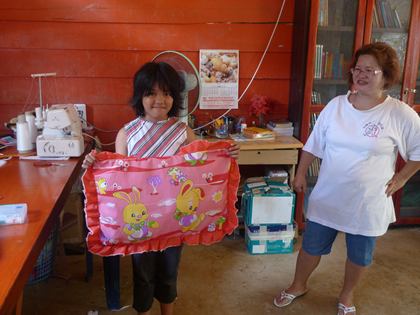
Last year, we started a livelihood center in our main schoolhouse. A sewing machine was bought, and girls were taught how to sew school satchels, pillow-cases, curtains, and a local dress (baju kurong). The project was a success from the very beginning.

Learning to sew
"This will sell for 4 Ringgit!"

Today, the center has 3 sewing-machines and an embroidery machine (that can do hemming and embroidery) and produces school-satchels for sale to our students, pillow-cases to the villages we serve, etc.

In a few weeks time, we will start teaching our students hair-cutting and other hair-dressing skills, One of our former teachers, who now works in a beauty saloon, will return as our instructress.

Next on the drawing-board is a welding workshop to teach young boys. This is a skill in high demand in the construction sties and the palm-oil plantations.