One plate of rice for five!

Recently I was in Laguna, Philippines visiting families that were part of Goducate’s Veg@table project – that aims to help poor families growvegetables in their yards for their own consumption.

I visited a row of resettlement houses that had been helped by Goducate’s Veg@table team and saw the little yards filled withvegetable (tomatoes, string beans, eggplants) and the proud “farmers” showing off their produce.

These poor people had been resettled by the government because their homes in Manila had been destroyed by a terrible typhoon a few years ago. Their new homes were simple one-room cement houses with electricity that could withstand the next typhoon. However, they wereover 2 hours away from Manila where their jobs were (if they had jobs then).

In their new settlement there were absolutely no jobs and many of them survive through the help of friends and relatives.

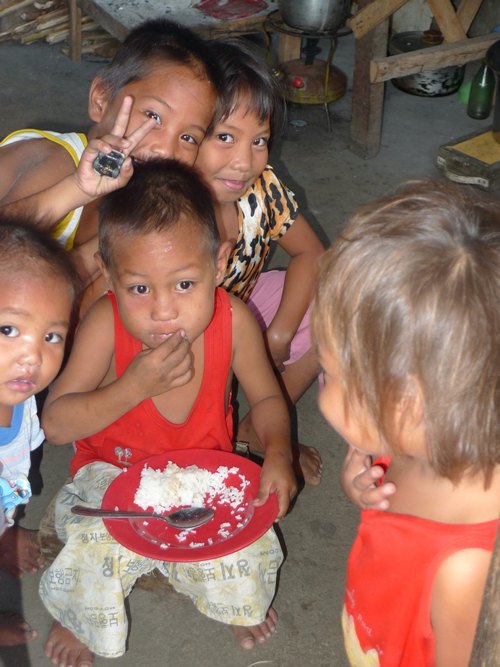
As I walked around the settlement, I was introduced to a man whose wife had just left him and their 5 children. The man had been injuredin a recent motor accident and was unable to work. When I visited them, there was exactly one plate of plain rice for the 5 children.One of the kids was deaf and he was eating out of the plate. The other four had nothing. I looked around the one-room house and there wasabsolutely no food in it – just an empty pot on a portable stove.

The little deaf boy gets to eat (note color of his sister's hair on the right)

With my medical training, I could see signs of malnutrition from their size, bellies and hair color.

The father asked for 20 pesos (50 cents) to buy some rice. We did more than that, we had already helped him to plant vegetables in his yard. Hopefully, one day soon those little kids will get to eat not only rice but also some freshly grown vegetable from their own yard!

Goducate has much work to do to help these poor people help themselves.
Aussies encourage our Sabah Literacy Centers

Our centers in Sabah was visited by Australians!

This Australian Chinese family was planning for a holiday at Hong Kong but later changed their mind to explore Sabah. They were able to see the proboscis monkeys and the flora and fauna of the jungle at the Labuk Bay and the Rainforest Discovery Center. Then they went on an adventure, that is visiting our literacy centers, walking on mud, riding a sampan and crossing a footbridge.

Our teachers are always encouraged when someone takes interest in their work and visits them.
Tom, the head of the family shared to our volunteers that love means giving. The way that they are giving their love in teaching these less fortunate children is what the world needs, he said. Pauline his wife, shared a true story about the housemaid who took care of his dad in old age. That time, the housemaid could not read nor write and had to ask someone to fill up immigration form. But this person instead of helping, took advantage of her by charging rm50 for his services. She also has to ask someone to interpret for her each time she receives mail from home. Later she learned to calculate, read and write taught by Pauline’s old Dad. I believe this sharing affirmed the value of what our teachers are doing.

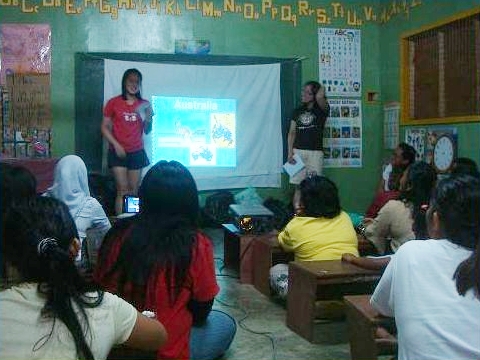
The most fun though was when their two daughters Mel and Sarah made a presentation about Australia, their food, the fashion there, and the animals that are found there. They taught our teachers English in Australian accent and Australian slang. It was so fun! When it was time to say goodbye, they taught them the slang expression for goodbye. But our teachers said, no, we don’t want to say goodbye, teach us how to say, come again!

The fun and high spirits brought by this visit cannot be dampened by the rains which kept on pouring. Hoo roo!

Our teachers learn about Australia

Goducate Training Center – utilizing local talent and materials

The aim of Goducate is to help Asians help themselves. If all goes well, Goducate Training Center in Iloilo, Philippines, will take in our first batch of trainees in April who will be trained to be creative, innovative and resourceful workers who can help needy Asians to maximize their talents and limited resources.

GTC has been designed to promote this Goducate culture. Where possible, local materials are used instead of expensive “imported” stuff. One of the reasons for choosing this piece of land was the abundance of untapped natural resources – its interesting terrain of hills, valleys and plains, abundance of water sources (5 fresh water springs), forests of bamboo and mahogany and many neglected fruit trees.

Goducate also chose the Philippines as the country to build its main training center because of the large number of well-educated, resourceful, hard-working Filipinos – many of whom are often under-optimized.

Recently I brought 2 friends from a large established training camp in the United States to check out our facilities and to advise us on camp development. They had helped us to choose this site and had seen it when it was still undeveloped 7 months ago.

They were shocked to see how quickly the site had been transformed into a well developed “city” with all the necessary infrastructure (of terracing, irrigation, roads, electrification) for future growth.

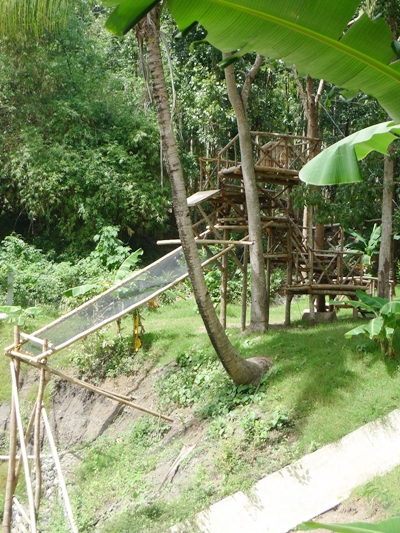
They were particularly impressed with how the terrain and trees were used to develop Sky-city. They were impressed with how the terrain and natural rocks were used to develop a swimming area. They were impressed with how our team designed a zip-line built entirely with local materials. It wasn’t exactly a “Disneyland” high-tech construction but it is safe and will help GTC generate funds to help pay for the expenses of running its training courses and its maintenance.

Zip-line tower using natural terrain and local lumber
Testing our locally made zip-line over aqua-culture pond
Swimming pool using natural terrain and local materials.

When the 2 camp ‘consultants’ were asked for their comments on the camp, this was the summary of their opinion: “Wow!”