Tilapia raising is not the only livelihood project that the Goducate Children’s Home is embarking upon. Goat raising is also a good livelihood project. Different species of goats have to be raised for different purposes. Although we would like to raise various species, we are at present focusing on producing organic-meat goats.
To maintain success with this project, we have started seeding various kinds of legumes, to be able to provide the animals with a complete plant food. In about a year’s time we will buy several female goats and one male.
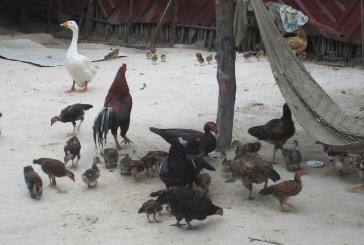
Chicken rearing is quite a difficult project that requires more care and monetary investment. However, our administrator’s experience with poultry has encouraged us to start breeding chickens as egg layers and as meat for sale.
The Goducate Children’s Home has long wanted to be self-sustainable. It has also wanted to teach the children at the home not only to stand on their own feet, but also to go and impart what they have learnt to the community. Over the years we have been gathering information and trying out various projects. Recently, our administrator, Noe Pulmones, went to the Philippines for intensive training in livelihood programs. We are now starting to introduce these programs, starting with short-range goals but with the aim of reaching long-term goals.
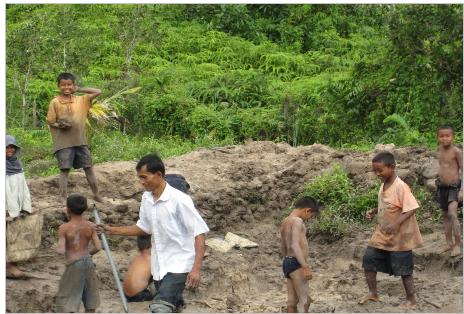
Feasibility studies have shown that raising tilapia for sale has more advantages than any other livelihood project. Thus during the Khmer New Year vacation, the boys at the home dug out two new fish ponds.
Goducate’s main training center in Iloilo, Philippines, where most of Goducate’s future community workers will be trained is fast taking shape.
The main objective of this Training Center is to produce workers who can educate Asia’s needy people to help themselves – especially in livelihood skills. As most of Asia’s poor live in rural areas, our trainees will spend much time learning modern, sustainable farming methods at the center. Of course, other livelihood skills (eg. literacy and numeracy teaching, computer skills, English for employment, engine repairs) will also be taught.
To ensure that the center will be financially sustainable in the long term, the center will also have revenue-generating projects. To take advantage of its proximity to Iloilio City and its pristine natural surrounding, eco-tourism and recreational activities are being planned.
Horse carriages will soon pass this wayThis rice field will soon be a recreational lake
As soon as the rice is harvested, the present area where we are experimenting with hybrid rice will be converted into a recreational lake with boating, recreational fishing and other recreational water activities. The hybrid rice will henceforth be planted in collaborators’ farms around the center.
Over the recreational lake we plan to have zip-lines, which will be the first in the province. There will also be horse-riding around the center and horse-carriage rides for families.
We also plan to have a restaurant serving food grown in the center – organic vegetables from our gardens, poultry, pork and mutton from our farm, fish caught from our lake, and fruits from our fruit trees.
We hope that the center will produce enough food for our trainees and our restaurants and that the revenue from these activities will pay for the upkeep of the center.
If Goducate Training Center does not help itself, then how can it train workers to help others help themselves?