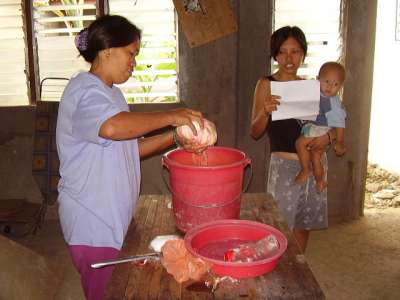
It’s the dry season in the Philippines in April and May, so it has been hard to keep the vegetable plots watered. Therefore those who have been taking part in our veg@table programme in Dayap are instead learning how to make liquid dishwashing soap from our livelihood trainer Jonatan.
Dayap is the resettlement village for people in Manila who lost their homes during Typhoon Ondoy in 2009. Most of the men still work in Manila in the week and come home only at the weekends. Hence it is the women who are around most of the time.
The two women in the accompanying photographs are already selling their soap. Goducate helped them with a loan of PHP 180 ($4) as start-up capital, which they will repay when they have sold all their products.
Jonatan teaching soapmakingThe first two candidatesThe other learners
The title “Herbal Soap Factory” sounds impressive. In most of our minds it conjures up the image of a spotless, high-tech factory with white-coated lab technicians. However, the Goducate Herbal Soap Factory is in a little wooden Goducate Learning Center building. And it is run by a few old ladies (one a widow) who have learned to make herbal soap for a livelihood.
Goducate soap maker
The technique of making herbal soap has been learned by Jonathan, the Goducate Learning Center supervisor at Mabakan, Laguna, from a government sponsored course. He has since transferred the skills to these ladies. The equipment is rudimentary – a few pails, many plastic molds to contain the liquid soap, some paper to wrap the soap. The raw materials are simple – caustic soda, vegetable oil and herbal essence, eg. crushed papaya, crushed guava leaves.
The ladies patiently stir the mixture of caustic soda, oil and herbal essence for about 30 minutes before the dark brown liquid is poured into the plastic molds. When the dark brown liquid is left to cool, it turns into pure white soap! When the soap is hard enough it is knocked out of its mold and left to “mature” for a month before it can be used.
The soap is then wrapped in simple paper and sold to their neighbors for 12 pesos (about US 20 cents). The proceeds from the sale of the soap are shared between the Goducate Center, the soap makers and those who sell the soap. So far sales are satisfactory. However, efforts are being made to produce smaller pieces of soap to sell to the nearby hot-spring resorts for their guests.
Finished product - quality herbal soap
Though the amount earned is small, soap-making encourages the spirit of enterprise among these people. Jonathan has also learned how to make dish-washing liquid and will be teaching the students at Goducate Learning Center to make and sell this soon.
Goducate wants to help Filipinos to help themselves through enterprise.
Nanay Linda.. ( Mother Lynn), everybody called her mother, for she is a mother of 16 children, including Lisa being the firstborn- our GD Day Care teacher/ ALS Student at the same time.
Nanay Linda is one of our beneficiary of soap-making livelihood, and just last week has also enrolled in our ALS (Alternative Learning System) Elementary level;
She told our teacher(s); Lisa (her daugthter) and Abegail, how she is very eager to read and write at the age of 50.