She now loves children, and loves helping them

What would you do if you were stuck in a cycle of poverty and the oldest child in the family? What if your mother continued to have children even though there was no food to feed the ones that were already born? How would you break free, where would you turn?

In Laguna I met L, a 30-year-old mother of 3 who shared with me her life story. She was nervous because of her level of English but I understood her quite easily. She shared that she’s one of 16 children, the youngest now 4. She grew up in a very poor village and was the oldest in her family. Their family was hungry, poor, and without much hope. At the age of 16 she married another boy from the village—because in him she found love and comfort that she so longed for. Being married meant that she wasn’t a burden to her parents any more; she was now to fend for herself. One year later a baby girl entered their lives. Because she was an older sister to so many children, she didn’t really desire to be a mother and told me that she even hated children. She certainly did not want to follow in her mother’s footsteps.

As L’s daughter grew up, a son was added to the family—then years later another son. She said 3 are plenty for her. I’m sure it’s still a struggle to keep a family of 5 fed but far more manageable than if there were more.

As she mentioned her hatred towards children, I could tell that there had to be a change in her at some point because her work now is directly linked with children. About 7 years ago her heart changed and softened regarding many aspects of life, including her acquiring a love for children. She continued to share that every afternoon her family travels by motorbike to a remote village to teach children there. Her daughter leads music lessons for the children while she teaches young children basic knowledge.

A dream L and her husband share is to establish a Goducate learning center in this village. I had the privilege of visiting this village, being welcomed by the children and parents alike. There is a plot of land next to the yard where they’re currently meeting that is for sale. They’re dreaming of getting that piece of land to build a center where she will educate the children of the village. Their family would move out to this village to help the people by living among them.

the village in which she grew up.
The village in which her family works and the children she teaches

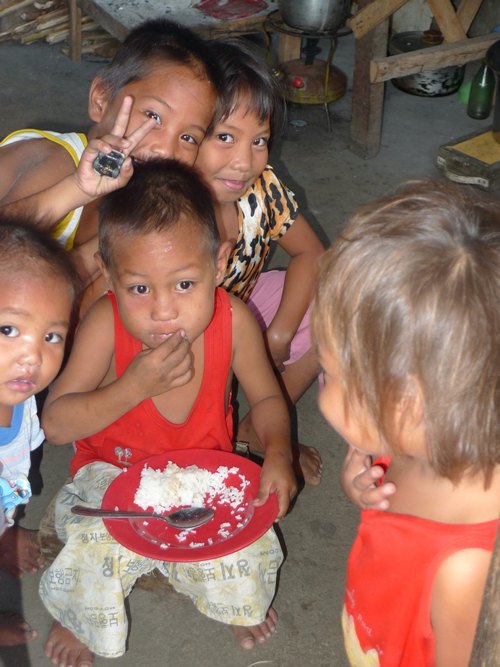
One plate of rice for five!

Recently I was in Laguna, Philippines visiting families that were part of Goducate’s Veg@table project – that aims to help poor families growvegetables in their yards for their own consumption.

I visited a row of resettlement houses that had been helped by Goducate’s Veg@table team and saw the little yards filled withvegetable (tomatoes, string beans, eggplants) and the proud “farmers” showing off their produce.

These poor people had been resettled by the government because their homes in Manila had been destroyed by a terrible typhoon a few years ago. Their new homes were simple one-room cement houses with electricity that could withstand the next typhoon. However, they wereover 2 hours away from Manila where their jobs were (if they had jobs then).

In their new settlement there were absolutely no jobs and many of them survive through the help of friends and relatives.

As I walked around the settlement, I was introduced to a man whose wife had just left him and their 5 children. The man had been injuredin a recent motor accident and was unable to work. When I visited them, there was exactly one plate of plain rice for the 5 children.One of the kids was deaf and he was eating out of the plate. The other four had nothing. I looked around the one-room house and there wasabsolutely no food in it – just an empty pot on a portable stove.

The little deaf boy gets to eat (note color of his sister's hair on the right)

With my medical training, I could see signs of malnutrition from their size, bellies and hair color.

The father asked for 20 pesos (50 cents) to buy some rice. We did more than that, we had already helped him to plant vegetables in his yard. Hopefully, one day soon those little kids will get to eat not only rice but also some freshly grown vegetable from their own yard!

Goducate has much work to do to help these poor people help themselves.

Aussies encourage our Sabah Literacy Centers

Our centers in Sabah was visited by Australians!

This Australian Chinese family was planning for a holiday at Hong Kong but later changed their mind to explore Sabah. They were able to see the proboscis monkeys and the flora and fauna of the jungle at the Labuk Bay and the Rainforest Discovery Center. Then they went on an adventure, that is visiting our literacy centers, walking on mud, riding a sampan and crossing a footbridge.

Our teachers are always encouraged when someone takes interest in their work and visits them.
Tom, the head of the family shared to our volunteers that love means giving. The way that they are giving their love in teaching these less fortunate children is what the world needs, he said. Pauline his wife, shared a true story about the housemaid who took care of his dad in old age. That time, the housemaid could not read nor write and had to ask someone to fill up immigration form. But this person instead of helping, took advantage of her by charging rm50 for his services. She also has to ask someone to interpret for her each time she receives mail from home. Later she learned to calculate, read and write taught by Pauline’s old Dad. I believe this sharing affirmed the value of what our teachers are doing.

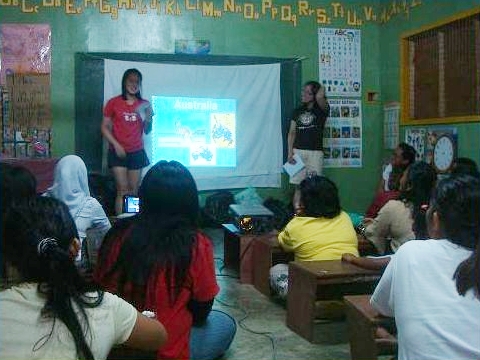
The most fun though was when their two daughters Mel and Sarah made a presentation about Australia, their food, the fashion there, and the animals that are found there. They taught our teachers English in Australian accent and Australian slang. It was so fun! When it was time to say goodbye, they taught them the slang expression for goodbye. But our teachers said, no, we don’t want to say goodbye, teach us how to say, come again!

The fun and high spirits brought by this visit cannot be dampened by the rains which kept on pouring. Hoo roo!

Our teachers learn about Australia