Goducate Training Center – utilizing local talent and materials

The aim of Goducate is to help Asians help themselves. If all goes well, Goducate Training Center in Iloilo, Philippines, will take in our first batch of trainees in April who will be trained to be creative, innovative and resourceful workers who can help needy Asians to maximize their talents and limited resources.

GTC has been designed to promote this Goducate culture. Where possible, local materials are used instead of expensive “imported” stuff. One of the reasons for choosing this piece of land was the abundance of untapped natural resources – its interesting terrain of hills, valleys and plains, abundance of water sources (5 fresh water springs), forests of bamboo and mahogany and many neglected fruit trees.

Goducate also chose the Philippines as the country to build its main training center because of the large number of well-educated, resourceful, hard-working Filipinos – many of whom are often under-optimized.

Recently I brought 2 friends from a large established training camp in the United States to check out our facilities and to advise us on camp development. They had helped us to choose this site and had seen it when it was still undeveloped 7 months ago.

They were shocked to see how quickly the site had been transformed into a well developed “city” with all the necessary infrastructure (of terracing, irrigation, roads, electrification) for future growth.

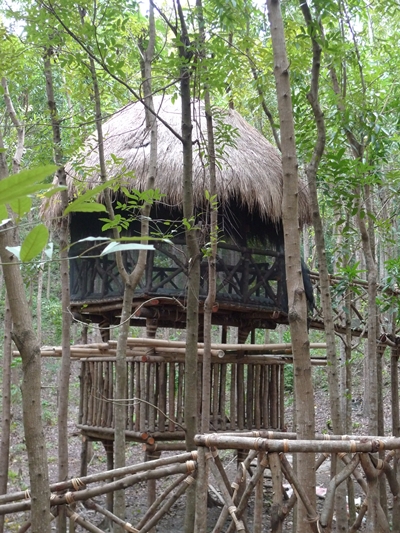
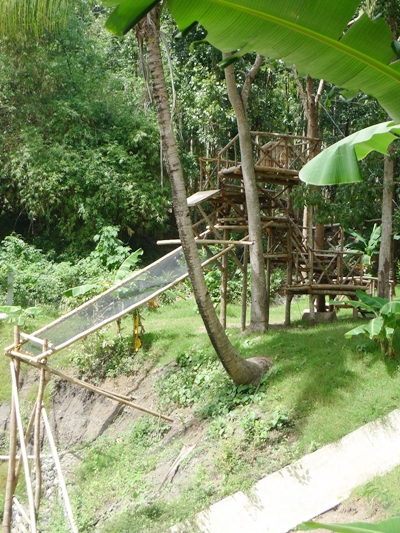
They were particularly impressed with how the terrain and trees were used to develop Sky-city. They were impressed with how the terrain and natural rocks were used to develop a swimming area. They were impressed with how our team designed a zip-line built entirely with local materials. It wasn’t exactly a “Disneyland” high-tech construction but it is safe and will help GTC generate funds to help pay for the expenses of running its training courses and its maintenance.

Zip-line tower using natural terrain and local lumber
Testing our locally made zip-line over aqua-culture pond
Swimming pool using natural terrain and local materials.

When the 2 camp ‘consultants’ were asked for their comments on the camp, this was the summary of their opinion: “Wow!”
Goducate Training Center’s abundant harvests

It was a pleasure to spend 3 days last week at the Goducate Training Center. The air was fresh, cool and windy. Some of our staff had to wear an extra layer of clothing – which is unusual in tropical Philippines! I walked up and down steep horse-trails panting and heaving but without perspiring.

The sight of the lush forests of tall tropical trees and bamboos was pleasing to my city-weary soul. However, the sight of food-bearing plants was not only pleasant to the eyes but also an encouragement to me that one day soon Goducate will be able to help needy Asians to put food on their tables. As prices of food rise beyond the reach of the poor, this need becomes more and more urgent.

Each day we feasted on the local produce of GTC – freshly harvested rice (it’s quite different from the supermarket varieties), vegetables, local range-chickens, melons. We ate heartily and confidently, knowing that we weren’t consuming steroids and other unnecessary junk.

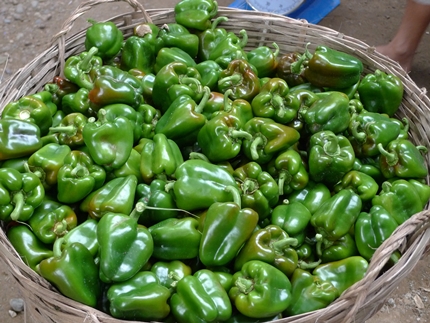
Super size bell-peppers
Super long chillies

The harvests have been so good that our neighbors who saw some of our produce (eg. the super large bell-peppers or capsicums) did not believe that they were produced locally. They insisted that these had to be from faraway Baguio (a mountainous area that is famous for premium vegetables).

Super laden mango tree

One of our mango trees has so many fruits on them that it is estimated that it will produce 1500 kilograms of sweet juicy mangos in April.

I hope to bring a group of Goducate supporters at the end of March/early April to enjoy the bounty of the farm and to meet its first intake of Goducate trainees.

Goducate Training Center aims to be eco-friendly

The Goducate Training Center in San Miguuel, Iloilo, Philippines is nearing completion.

In line with Goducate’s philosophy of helping Asians help themselves, it aims to be eventually self-sustaining through the production of food for consumption and through revenue-generating activities that are in line with its philosophy of “education”.

GTC also aims to be eco-friendly.

Its slopes have been carefully terraced with sloping agricultural land technique (SALT) and planted to prevent erosion.

Many of its buildings are made of locally grown materials (mahogany and bamboo). The entire “Sky-City” of huts, walkways and toilet facilities is made of locally grown materials.

Sky-City hut made of mahogany, bamboo and dried grass
Sky-City "lobby" made of mahogany and bamboo

The restaurant and many other buildings are largely constructed of local materials. The lamp-posts are made from mahogany trees from our own forest. Even the structure for the zip-lines are made of locally grown mahogany lumber.

Water for the entire site is provided by 5 fresh-water springs and run-off water from the roof of the Multi-Purpose Hall. Some electricity is produced by a small hydro-electric generator that is propelled by run-off water from our impounding lake.

Horses will provide transportation on the site – instead of gas-guzzling and carbon-producing vehicles.

Pollution-free transportation that trims the grass and produces organic fertilizer

We hope that Goducate Training Center will train workers who can help the poor help themselves, without destroying the environment.