

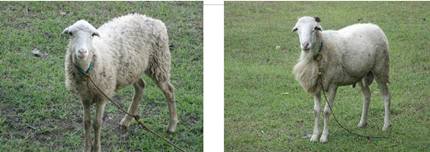
Six white bundles of joy arrived past midnight at the Goducate training center in San Miguel, Iloilo, The Philippines, a fortnight ago. The ram and five ewes are gifts to Goducate from Mr. Manny Delleva, a successful agri-entrepreneur from nearby Negros Island. They are hair sheep—ie, they grow more hair than wool, and are thus easier to take care of.
The ram is of Katahdin breed while the ewes are of St. Croix’s. The parental stocks were imported by Mr. Delleva from the US Virgin Islands in 2010. These sheep are excellent breeders. If allowed to fall in love unrestrained, each mature ewe can lamb twice a year with twins and occasional triplets and quadruplets. They have sweet faces and disposition, don’t jump on you, over you, or over the fence, and thus make excellent pets. They eat practically anything, even gmelina seeds, so they are excellent weed eaters and lawn mowers. They taste good and are an excellent source of lean organic meat. They adapt easily to tropical environment and are resistant to parasites and diseases common to small ruminants.


On their first day at the training center, the hierarchical “leadersheep” was immediately evident. The eldest ewe took charge and, being accustomed to range management, it led the flock in exploring the hillsides where they liberally took bites at whatever greens they found. A team of camp workers went after them, roped the leader, and towed it back. Sheep have a strong instinct to follow the one in front of them, so it was easy to bring back the rest of the flock into the open field. From then on, every day the eldest ewe has been harnessed by a rope secured to a stake to avoid a repeat of the “wandering” incident. The ram has also had to be restrained because it tends to take a secondary “leadersheep” role leading the younger ewes to the vegetable patch on taste-test sorties.