Goducate agricultural consultant from The Philippines helps center in Sabah

Goducate has been training Filipinas who are undocumented aliens in Sabah to teach literacy and numeracy to the children in their own community. There are now 22 Goducate literacy centers catering to over 1000 students.

In another town on the other side of Sabah a Malaysian couple, concerned about how street kids usually end up as child laborers, troublemakers, or victims of child abuse, had also set up a center to teach literacy to the children of undocumented aliens. The husband had grown up in a village where he had learnt some farming, and he believes that a school that teaches practical organic agriculture to out-of-school youth could help transform their condition from one of hopelessness to one of usefulness. Hence they were also starting a little farm.

They turned to Goducate for help with their farm project, and thus it was that I found myself there for 5 days to train them in some agricultural techniques—namely, vermicomposting and vermitea brewing, hydroponics and aquaponics, organic container gardening, and organic moringa production. The first 2 days were spent teaching with powerpoint presentations and discussions, and the next 2 days were spent with hands-on work at the farm. The last day was spent on mapping the area for optimum land use and a field visit to a nearby vermiculture project.

The big dream of this center is that the farming project will end up as a center for organic farming initiative that can contribute significantly to the food security of Sabah. For now, it is a means of turning out-of-school youth into useful and productive citizens instead of troublemakers.

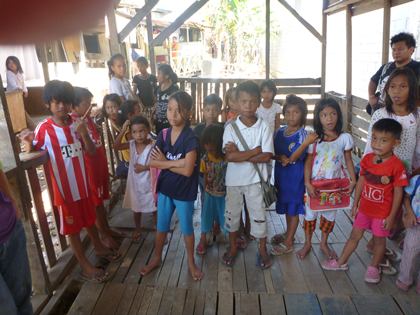
Stateless children with no access to state education
Children attending class at the literacy center
The classroom-dormitory under construction

GTC trainees learn how to GO and EDUCATE

Two weeks into their six-month training and the new batch of international students at the Goducate Training Center are all primed up to becoming effective community development workers in Asia. The course contents are quite diverse but the main emphasis is on teaching them how to teach needy Asians help themselves through practical but scientific technologies to produce safe and wholesome farm products. Through hands-on training, they will learn how to follow good agricultural practices to ensure social, economic, and environmental sustainability—knowledge that they should be able to pass on to farmers and members of their household.

The diversity of the students goes beyond culture because they also vary in age, gender, and academic background. The common denominator, however, is their passion and eagerness to become effective change agents. Their first few days at GTC were spent on acclimatizing, bonding, getting acquainted with the faculty and staff, and learning the basics of various courses. For practicum, they had already been exposed to actual seed planting and harvesting of moringa pods, corn, rice, and fish.

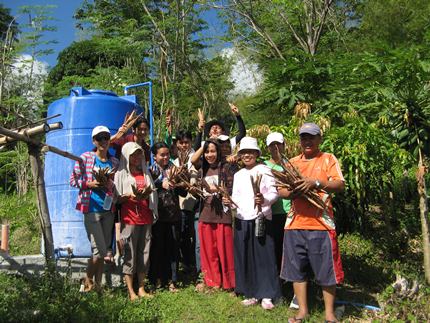
Harvesting moringa pods the Indonesian, Malaysian, and Filipino way
the Cambodian way
Students in the container garden with the corn they plucked

The following are impressions shared by some of the trainees:

“Before I thought that agriculture is boring but soon things turned 180 degrees for me. I learned to appreciate and love it. I was amazed to learn that plants can be successfully grown in nutrient-rich water. And to pluck a corn cob from its stalk for the first time ever? Simply amazing! I’m so excited to learn more .” —Jean, Malaysia

“I am very thankful to all my sponsors for enabling me to study at GTC to learn many things especially about agriculture. Coming from a children’s home and to another country for the first time, I am overwhelmed by the new and rich experiences. Surely I will have a lot to share with my own people after completing my study here.”—Nathan, Cambodia

“It’s a great privilege to be at GTC. In the beginning I thought agriculture is very boring but during the lecture on recent trends that included tissue culture, biotechnology, hydroponics, bubbleponics, aeroponics, and aquaponic, my interest on these things went up several notches. Now I am an eager student of agriculture.”—Lexon, Indonesia

“Magnificent. Intensive. Flexible. These are how I describe the place, training and fellow trainees. Magnificent in the sense that GTC is a venue where we can learn a lot of skills that can never be learned from a four-walled traditional classroom. Intensive because theory combined with hands-on are being taught by brilliant mentors and facilitators. Flexible as the six month-training is continually attuned with the absorptive capacity of its international students. As one of the future GTC-trained community development workers, I must therefore GO and EDUCATE!”—Nini, Philippines

Goducate Training Center models rice-fish farming system

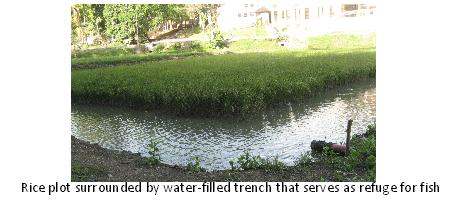
At the Goducate Training Center in Iloilo, Philippines, our agriculture team is modelling a rice-fish farming system in support of Goducate’s “GoFeed” mandate. The results, so far, are promising. The agronomic performance of the rice plants are impressive and the fish are progressively increasing in size and weight.

Popularly known as rice-fish culture, this technique is significant for its symbiotic relationship feature. The fish eat insect pests, fertilize the plants with their droppings, and aid in oxygen circulation. In turn, the rice plants provide shade to the fish, protect the fish from predators, and supply supplemental feeds through decaying leaves.

Two rice plots, approximately 600 sq m each, were prepared by digging perimeter trenches measuring two meters wide and one meter deep. The trenches serve as refuge for the fish during intermittent draining of the ricefield. After planting, each plot was separately stocked with 1,000 fingerlings of Nile tilapia (Tilapia nilotica) and African catfish (Clarias gariepinus). Starter feeds were given for the first month. After that floater feeds were supplied.

Our visitors have seen the practical and replicable aspects of the rice-fish model. The major requirement to succeed in this technology, however, is reliable water supply. A distinct advantage at GTC is the presence of a water impounding project which ensures the technical feasibility of integrating fish with rice throughout the year.

There is empiricial evidence that rice-fish culture can increase rice yield up to 10%. Aside from supplying the staple and protein needs of the household, it also has the potential to produce a net farm income that is about five times more than what a farmer usually realizes from rice monoculture.