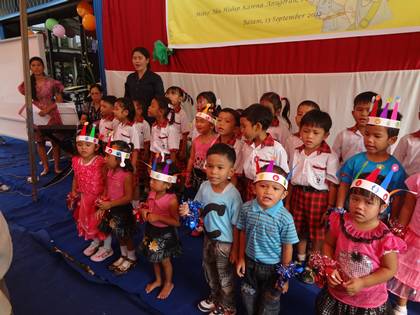
In July, Goducate started a kindergarten in Batam for a nearby community. The kindergarten, called Sekolah TK Lentera Anak Bangsa (Light of the Children of the Nation Kindergarten School), was formally opened on Saturday by Goducate founder Paul Choo and the village head. Most of the day’s program, however, saw the participation of the kindergarten’s 26 students. The children come from a poor sprawling neighborhood of some 2000 huts with no running water.
Parents, some students, and guests at the openingin classroom preparing for performance
The kindergarten is housed in a shophouse a short distance from the neighborhood from which most of the children come. There are two classrooms downstairs, one for the 6-7-year-olds, and one for the under-6s, and a long activity room upstairs.
The three-pronged philosophy behind the kindergarten is to staff it with good teachers, to involve the cooperation of the parents in the children’s education, and to put an emphasis of the teaching of English. Goducate hopes that this approach will give the children a good start in their preparation for life in today’s international world.
Teaching literacy is likely to be one of the common tasks that Goducate’s community development workers will have to do when they finish their training and are sent to work among the needy. Even in places where the population is entitled to free state education, many children are unable to go to school, at least not regularly, because the family cannot afford the incidentals such as books, uniforms, or transport, or because the children have to be pulled out to help earn a living or look after younger sibs.
For their practical training in teaching literacy, students at the Goducate Training Center (GTC) in Iloilo go out into the neighbouring communities on Saturdays to conduct classes in literacy.
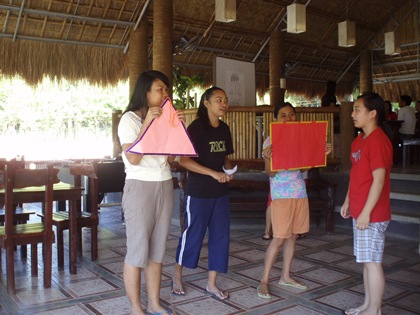
Practising using a game to teach shapesTeaching through song
Recently I spent a couple of days at the Goducate Training Center and was impressed by how conscientiously and enthusiastically the trainees prepared for these sessions in the community. They are trained not to teach didactically. Instead, they spend much effort preparing how to capture their students’ interest and attention through creative visuals, songs, and games. Lunch breaks were used to prepare the visuals, and time was set aside to practise thoroughly how they would deliver their lessons. It was good to see them enjoying their practice. Their enthusiasm should rub off on their students.
Last year, Goducate published a book of articles by the children living at the Goducate Children’s Home in Cambodia. The pieces in “In The Shoes of a Cambodian Child” give an insight into what goes on in the minds and hearts of children from dysfunctional families and how their experiences have affected them.
This year Goducate will be producing a collection of articles by some of the needy children being served by Goducate in The Philippines. Unlike the children at the Goducate Children’s Home, the Filipino children are living in the community with their families, though not necessarily happy ones, nor their immediate ones. As is well known, many Filipinos go abroad to work, leaving their children behind in the care of others. Thus “In The Shoes of a Filipino Child” will also feature stories of emotional hardship as well as physical hardship. But there will also be stories of what makes them happy, and it is touching to read of what simple things are enough to bring them a little bit of joy in life. We hope that the stories by these children will create awareness among those who are comfortably off about how much poverty there is in the world around them.
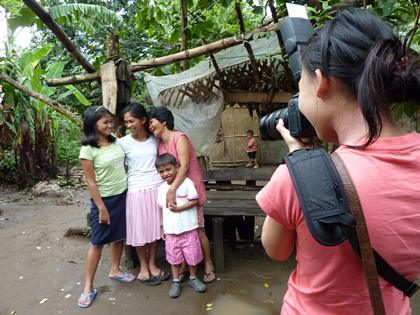
For the coming book, a team from Goducate went to get photographs of the children who have contributed to the book. Our timing was bad. It rained very heavily nearly all of the three days that we were there. Manila was especially badly affected by one of the most serious floodings in decades, and there were 60 deaths from the rains reported while we were there. Although we were about an hour’s drive away from Manila, some of the villages and homes we had to visit were also flooded. Seeing people in their homes cooking a meal while standing more than ankle-deep in water as though it was the most natural thing to do made us realize how frequently they have to go through these hardships. However, at least they had electric lights at night, unlike those families relocated after their homes in Manila were destroyed by Typhoon Ondoy in 2009. Those families in the relocation area are still waiting for electricity, and one of the children has written of the hardship of not having any light to work by at night.
Our photographer Annabel at work during one of the very few dry spellsOur team having to wade in muddy water to get our photographs