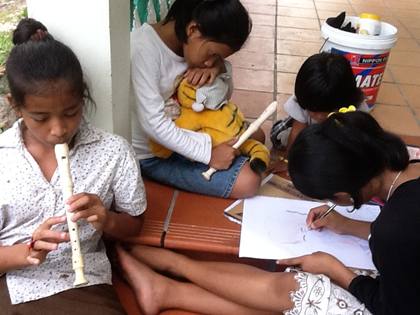
Life at the Goducate Children’s Home is not all about schoolwork and duties around the home. In their spare time in the late afternoon the children can choose to play football, play basketball, fly kites, play their recorders, draw, paint, or do whatever else they like. Recently, they have been able to attend karate classes if they wish. Karate expert (Hanshi) Patrick Fallay and his wife Myrine have been volunteering their services two afternoons a week. Uptake has been good, with most of the children, even the youngest one (4 years old), opting for the classes. Needless to say, it’s drummed into the children’s head that karate is for self-defence, not assault. For now, it’s good fun, good exercise, and good discipline.
Music and art leisure pursuitsKarate class
The children get occasional outings too. A couple of weeks ago, they spent a whole day on the white sandy beach and in the clear water at the Sokha Beach Resort in Sihanoukville, where the management kindly threw in free rides on the banana boat, which was towed out into the sea by a motorized boat.
Children preparing to go out for ride on banana boat
The Goducate Children’s Home in Prey Nob, Cambodia is home to more than 30 children. Most of them come from challenging family backgrounds—orphaned, unable to live at home with their parents, from single-parent homes or simply abandoned. They are looked after by a Filipino couple Noe and Grace, who, together with two assistants, provide a loving environment, where the children have a chance attend school, and within months, flourish with joy and confidence.
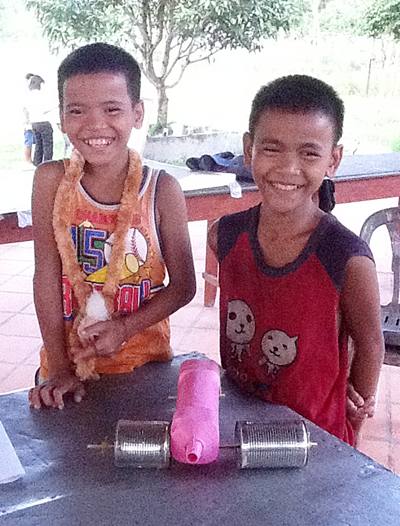
With Goducate’s vision to help children in poor communities in Asia through education, the transformational changes in the lives of the children is clear. Listening to Caleb, I found his story a living testimony. He is 13 years old. Before joining the home, he used to be a garbage collector and was unable to attend school. His father sent him out to rummage for aluminum cans and plastic bottles in the streets all day to earn a meager sum of less than 25 cents to help put food on the table for his family. His face bears the scars of scratch marks, from other children fighting over the same piece of garbage with him. Now, he shares with me, that he is glad he has a new life. He has new friends. He is able to have the chance to go to school daily, to learn to read and write. He also learns livelihood skills such as tending to fruit and vegetable crops, rearing chicken, and looking after tilapia in the fish farm at the home.
Caleb (in red, with his brother Titus) with airplane he made out of discarded plastic bottle and tin cans
With the mission of Goducate to provide opportunities for children to help themselves through accessing education and learning skills foundational for future self-supporting and self-sustaining enterprises, new and bold dreams are being shaped. In the local community, where subsistence farming is the main occupation, Caleb dreams of being a scientist in the future. Other children shared their aspirations of being doctors, teachers, and even prime minister of their country. These are the dreams of the next generation, emerging from the shadows of the brutality of the dark past of wars and massacre. I am thankful I, a Singaporean, had a chance to see Goducate’s work in building bridges for the children and youth in our neighboring countries to reach further towards new possibilities.
Preparing ground for growing peanuts
Children tipping manure carried from chicken coop to base of tree
As I made my journey home, after spending five valuable days with the children, memories of Caleb and many other children smiling have left a deep impression of the hope and potential that Goducate, through love, care and commitment through education, has brought to many in Cambodia.
Thanks to the generosity of sponsors, the Goducate Children’s Home has a new schoolhouse, where the children have been having their lessons since the start of this school year a month ago. The one-room schoolhouse was built largely by the older children and the staff, with the help of some friends.
Children at their desks. Girl with flag raised awaiting help from teacher.
The children follow the US-based School of Tomorrow home-study program. During class the older ones sit in their own booths, while the younger ones have little desks or share a long table. Each child has a flag, which he or she raises—by putting it on a high ledge in the booth, or holding it up—whenever help is needed from one of the teachers. The booths and the desks, too, were home made by the older students.
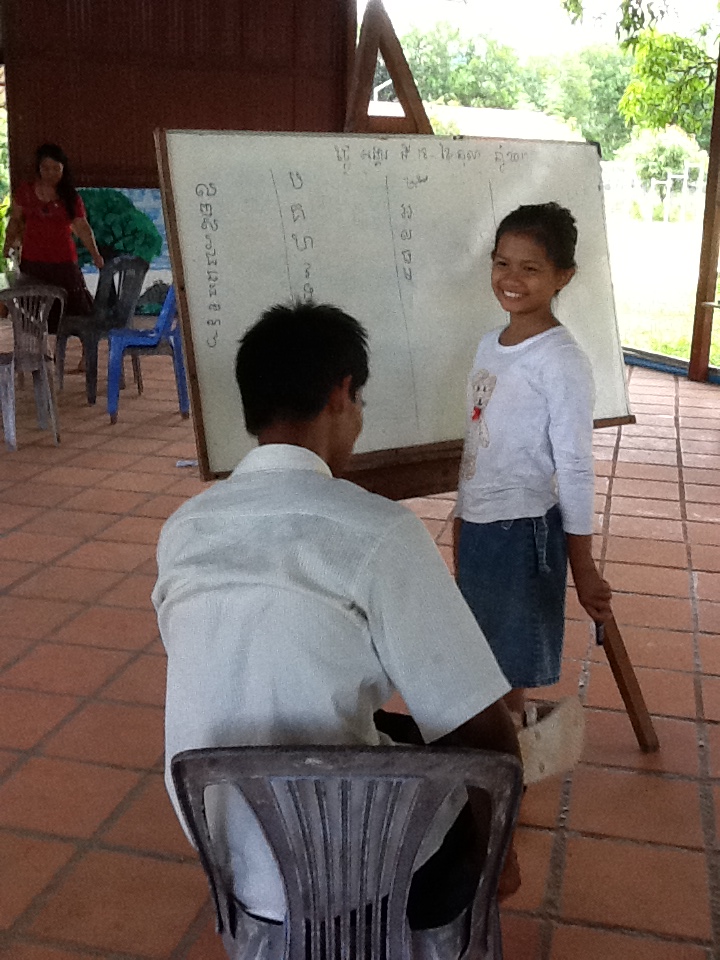
The children are also taught the Khmer language so that when they leave the home they can fit in with and help their own community. The Khmer is taught in the conventional way—ie, by a teacher rather than through home study—and the classes are held in the dining hall.
Khmer lesson
Their help with the construction of the schoolhouse and the school furniture is part of their livelihood training.