Goducate system of using mums as teachers in Sabah catches on

One of the most difficult things about doing work in far-flung and poor communities is getting enough workers to go out and stay the course. When Goducate was faced with a community of hundreds of thousands of people in Sabah with no access to state education, the thought of finding enough teachers to educate the children there was mind boggling. But we realised that the mothers who had had some education could be trained to teach the children literacy and numeracy. In the past 3 years we have opened 24 literacy centers staffed by nearly 60 teachers and assistant teachers. The teachers meet every every month and undergo periodic re-training and upgrading. Well over 1000 students have passed through those centers. Some have been able to find work outside, while some have stayed on as assistant teachers.

A literacy center that has been operating for the past 6 years in another part of Sabah, about 5 hours’ drive away from where we are operating, heard about how we trained mums to be teachers and invited us to share our system and our curriculum, to help them expand their work.

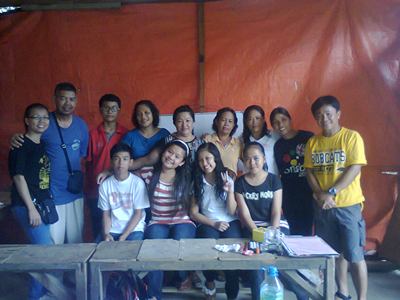
About 2 months ago, when I brought our team of our supervisor, two teachers, and our transport manager to help them, there were 10 trainees waiting for us. Some of them had been teachers in the Philippines. The rest, who were teenagers and mothers who had had some education, were very nervous because they thought that trainees had to be highly educated people. But when they learnt that two of our teachers were mums-turned-teachers, and one was a teenager who was a student-turned-teacher, they relaxed and were able to take part fully in the training, and to ask questions freely during the discussion time.

From the updates that we have received from that center, our system and our curriculum are being implemented by them smoothly.

Training session
Trainers and trainees

Goducate Teachers’ Day in Sabah

After four months of teaching this year, the teachers in the Goducate literacy centers in Sabah gathered for a day specially organized for them. Teachers’ Day was held at a function room at the town’s Sports Complex. 60 teachers, including the assistant teachers and the livelihood trainers, attended. In the morning we had our meeting, our team-building exercise, the evaluation of the Comprehensive Exam Results, and the distribution of mid-year bonuses (based on students’ exam performance), and our monthly birthday celebration. In the afternoon, we relaxed in the swimming pool, and some of the assistant (teen) teachers played their newly mastered game, the frisbee.

The teachers had mixed feelings about their pupils’ exam results (352 out of 544 passed) but almost all of them were very satisfied with the evaluation, which was properly administered by the team of examiners. The evaluation indicates how the pupils mastered and applied the lessons they had learnt, and it helps us assess the effectiveness of our curriculum and how it ought to be modified for the rest of the school year.  Overall, the teachers were very proud of themselves, and they committed again to do their best next time.

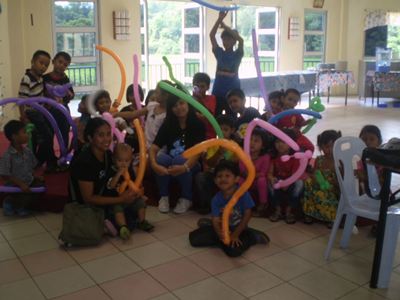
That event was unusual in that it was also a family day since the teachers brought their own children along, in that it was an exposure trip for some who had not been to the sports complex or into a swimming pool, coming as they do from primitive villages. While we were having our session in the morning, the children were taught balloon art.

All the teachers enjoyed the short time they had casting off their roles as teachers to playing around like pupils. This beneficial and recharging activity for our teachers should give them the energy to drive extra miles in the world of teaching and learning.

Children learning balloon art
May's birthday celebrants
Morning Session in air-conditioned comfort
Teen teachers bonding with adult teachers

Goducate agricultural consultant from The Philippines helps center in Sabah

Goducate has been training Filipinas who are undocumented aliens in Sabah to teach literacy and numeracy to the children in their own community. There are now 22 Goducate literacy centers catering to over 1000 students.

In another town on the other side of Sabah a Malaysian couple, concerned about how street kids usually end up as child laborers, troublemakers, or victims of child abuse, had also set up a center to teach literacy to the children of undocumented aliens. The husband had grown up in a village where he had learnt some farming, and he believes that a school that teaches practical organic agriculture to out-of-school youth could help transform their condition from one of hopelessness to one of usefulness. Hence they were also starting a little farm.

They turned to Goducate for help with their farm project, and thus it was that I found myself there for 5 days to train them in some agricultural techniques—namely, vermicomposting and vermitea brewing, hydroponics and aquaponics, organic container gardening, and organic moringa production. The first 2 days were spent teaching with powerpoint presentations and discussions, and the next 2 days were spent with hands-on work at the farm. The last day was spent on mapping the area for optimum land use and a field visit to a nearby vermiculture project.

The big dream of this center is that the farming project will end up as a center for organic farming initiative that can contribute significantly to the food security of Sabah. For now, it is a means of turning out-of-school youth into useful and productive citizens instead of troublemakers.

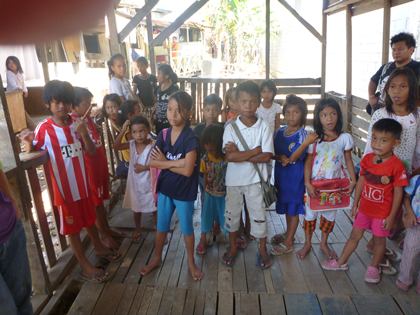
Stateless children with no access to state education
Children attending class at the literacy center
The classroom-dormitory under construction