Goducate staff will cross any bridge to train teachers

Goducate now has 17 learning centers in north east Sabah, manned by 34 teachers and 11 assistant teachers. Last month we were invited to two areas some distance away to train the people there to conduct our literacy programs. At the village 200 km away, we went to follow up on training that we did last year. At the village 400 km was new to us. I brought with me two of our teachers and an assistant teacher.

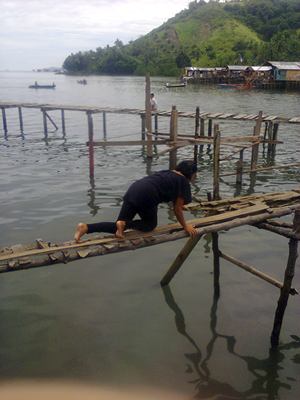
Safest way to cross a shaky jambatan
Goducate team with local partner (in the background)

Many of our villages are built on swampy land or over the water, so we are very used to shaky “jambatans” (bridges). But nothing prepared us for the shakiness and flimsiness of the jambatans we had to cross at the village 400 km away. These jambatans consisted of nothing more than pairs of thin planks held together by a few rusty nails. Worse, there were no bars, or poles, or ropes to hang on to for support. Some of us took off our footwear; another felt that the only way to maintain balance was to go on all fours. But all knew how important it was to get across the bridge, for waiting at the other end were people hungry for our help.

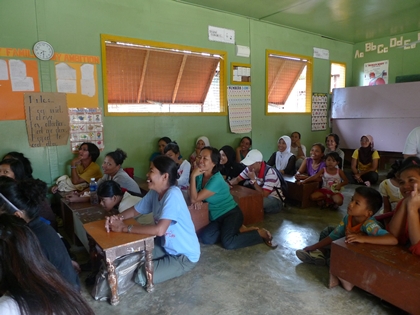
One of the locals participating in the training session; he was one of the two later appointed to be teachers

15 people attended our training session that day. From among them we selected one supervisor, two teachers, and two assistant teachers. We hope they will be able to use our program efficiently. For ourselves we hope to cross this bridge again, in follow-up training.
 

Goducate plans expansion of livelihood training in Sabah

Our Sabah Goducate literacy centers have produced over 2000 literate young people in the past 3 years. Many of our graduates have gone on to get jobs as waitresses, shop-assistants, receptionists, etc. These are jobs that were out of reach for them before Goducate came and taught them how to read, write, count, and speak English.

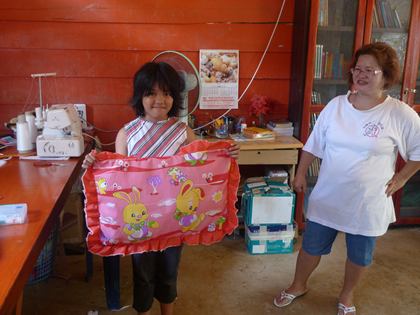
Last year, we started a livelihood center in our main schoolhouse. A sewing machine was bought, and girls were taught how to sew school satchels, pillow-cases, curtains, and a local dress (baju kurong). The project was a success from the very beginning.

Learning to sew
"This will sell for 4 Ringgit!"

Today, the center has 3 sewing-machines and an embroidery machine (that can do hemming and embroidery) and produces school-satchels for sale to our students, pillow-cases to the villages we serve, etc.

In a few weeks time, we will start teaching our students hair-cutting and other hair-dressing skills, One of our former teachers, who now works in a beauty saloon, will return as our instructress.

Next on the drawing-board is a welding workshop to teach young boys. This is a skill in high demand in the construction sties and the palm-oil plantations.

Goducate’s amazing teachers in Sabah

Last week I visited our Goducate Literacy Centers in Sabah. Presently there are 16 centers (possibly 17 by next week) in 16 different villages that provide education to children who have no opportunity to go to school because they are “undocumented aliens” from The Philippines and Indonesia. These are the children of migrant workers who have come to look for work in Sabah’s plantations and construction sites. The “stars” of these literacy centers are the teachers—most of whom are mothers of our students, or former students who have “graduated” from these centers. I am always amazed by their passion to teach, their willingness to learn, their dedication to their students—in spite of the primitive conditions of their “classrooms”, the meagerness of their remuneration, and the constant fear of the local authorities.

One of our former students, T-t, aged 17, is now a teacher. T-t was a student at our center for about 2 years before she was promoted to be an assistant teacher and then a teacher. A few months ago, she was offered a job as a receptionist in an “upmarket” spa because of her poise, her ability to speak a little Mandarin, and her fluent English (a skill she picked up at our center). This was indeed a dream come true for her and a first for the entire village! The starting-pay was RM 500/month – which is what most “undocumented” adults hope to earn.

After 2 months in this cushy dream-job she felt an “emptiness” (in her own words) and decided to return to the village to teach—for RM 100/month! She told me with tears in her eyes: “I just love to teach!”

T-t the dedicated teacher


Mums (seen here at teachers' meeting) make great teachers


T-t exemplifies Goducate’s philosophy of helping Asians help themselves—and who then help others help themselves. We are so proud of our Sabah teachers!