First Goducate musician to pass music examination does so with a merit

Goducate’s music program in The Philippines was started as a means of getting out-of-school youth off the streets and out of trouble. We started with recorder lessons, which were so popular that many children still in school or college also joined in. The youth were so musical they soon went on to other instruments and formed an orchestra that was engaged to play at local functions.

The trainers in the music program have had some music lessons but not at any high level. Thus when Channel News Asia brought some music trainers from Singapore to visit the orchestra in Laguna for a TV program called Once Upon a Village, the Singaporeans were surprised to find that the violinists knew nothing about tuning a violin.

Still, the Singaporean trainers were sufficiently impressed to invite 5 violinists to Singapore for about 10 days of training at the Wolfgang Music Studio in Oct/Nov 2011. The studio later invited one of these 5, Liezl, back on two more occasions, each time for a couple of months, to prepare for the Trinity College London grade 5 examination. She took the examination in June, and has passed with a merit.

She is now back in The Philippines passing on the skills she has learnt to the others in the music program. She has been invited to return to Wolfgang Music Studio later this year to prepare for the grade 6 examination.

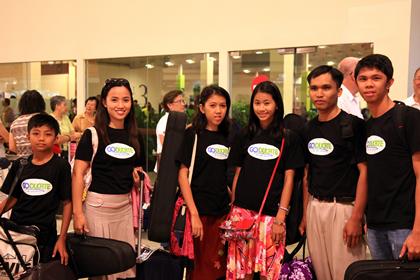
Liezl, second from left, and Jayson, extreme right.

Jayson, another of the 5 who came to Singapore through the Channel News Asia program, was also invited back for a couple of months training recently. He too has been invited to return later this year to sit for exams. Meanwhile he, too, is passing on whatever skills he has learnt to other Goducate musicians.

Both Liezl and Jayson exemplify the Goducate philosophy that those who have been helped by Goducate should in turn help others.
Secret of “humongous” crops at Goducate Training Center is in vermitea

Many people think that the humongous plant cultivars with upsized leaves, fruits, tubers, bulbs, heads, rhizomes, and grains that taste delicious grown at the Goducate Training Center are a result of application of commercial fertilizers, or maybe of abundant sunshine. Or maybe even of the use of synthetic hormones. The secret, though, is in the use of the vermitea that we brew and apply to plants by soil drenching or foliar spraying.

African Night Crawlers
Vermitea brewer
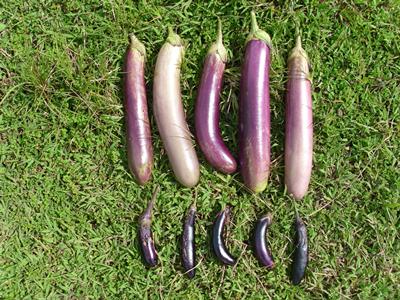
Eggplants with vermitea (upper row) and without vermitea (lower row)

To produce vermitea, earthworm casting (excrement) or vermicast is needed. At Goducate Training Center, we raise African Night Crawlers in pre-composted livestock manure mixed with rice straw and shredded leaves and twigs of leguminous plants. The vermicast is then brewed with chlorine-free water and molasses for 72 hours. The resultant vermitea should have a pleasant, earthy smell. If it smells awful, it indicates that bad microbes have overwhelmed the population of good microbes, and thus should be discarded.

The vermitea can be mixed with plain water in various concentrations. As much as 300 liters of sprayable material can be produced from only 1 kg of vermicast. The vermitea is applied within 8 hours from harvesting to maintain the potency of the aqueous extract. It should be applied once a week but we have found that spraying 2-3 times a week produces dramatic results.

Okra leaves without vermitea (left) and with vermitea (right)

Vermitea teems with microorganisms that include bacteria, fungi, protozoa, and non-harmful nematodes. They build a good microbial community in the soil and, over time, outnumber the bad microbes. They protect the roots as well as nourish and feed the plant. Roots penetrate wider and deeper. Unlike vermicast that takes days to mineralize and become available for root uptake, vermitea is readily absorbable when applied as a foliar spray. The microbes also attach themselves to the leaves and overcome the pathogens that cause mildew, black rot, and early blight. Vermitea also suppresses several other plant diseases as well as populations of spider mites (Tetranychus urticae), aphids (Myzus persicae), and plant parasitic worms that cause root cysts on tomatoes.

Our experience with vermitea has reflected research that has shown how vermitea has increased the germination, growth, flowering, and yields of various crops. We hope that we can pass this experience on to the needy to help them help themselves.

Goducate starts more literacy centers in Laguna

So far this year Goducate has started 3 new literacy centers in Laguna, The Philippines, giving us a total of 5, which together have 72 students. Most of the students are pre-school children, though there are some older ones, who for various reasons are unable to attend school.

At two of the new centers the students were so keen to start that lessons have been held in very temporary structures. At Ulik lessons have been conducted under a tent, which also serves as a shelter for our music students in the area. At Burol, lessons have been held in the open, at first with students sitting on banana leaves, then as more joined the class, they sat on tarpaulin sheets.

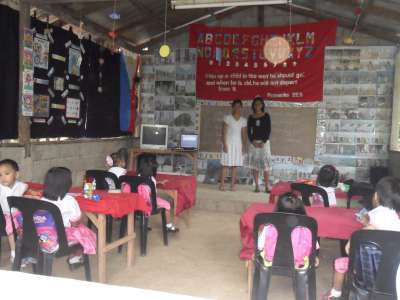
New literacy center at Talahiban
Literacy class conducted under a tent at Ulik
Students sitting on banana leaves
Students attend class sitting on tarpaulin sheets

Last month we were privileged to be visited by Goducate’s literacy trainer who is based in Iloilo, who came to motivate and upgrade our teachers. Her training sessions were attended by Goducate staff and volunteers as well as by some of the mothers of the students.

We were also very pleased last month to received from the Department of Education in Bay, Laguna, a certificate of appreciation for the Goducate literacy program. It signifies recognition that our program is a valuable support for the Department’s program.