Goducate Model Farm helps the community

It’s been nearly a year since the extended Goducate Model Farm in Laguna went into operation. The aim of the model farm is to train community workers in organic ways of planting vegetables, in various forms of crop production, such as container gardening and hydroponics, in various forms of composting, and in farm management. These workers would then be able to help needy communities produce their own crops.

From about mid-year, there has been a series of harvests of the range of vegetables grown at the farm, as well as of papayas and bananas. What is not used for feeding the staff and for Goducate’s feeding program in the community has been sold either locally or in Manila. Staff enjoy some profit-sharing, and the rest of the income goes towards covering the expenses of the farm.

Residents in Blu-Paong prepare beds for their crops
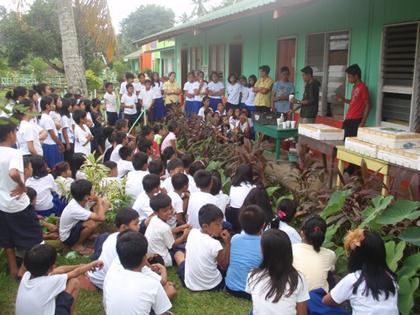
Students at Tranca Elementary School watch demonstration on planting
Students at Tranca Elementary School plant seedlings

The Goducate Model Farm also serves as a place of training and of employment of some out-of-school youth. Two who are employed as cleaners are being trained in vermicomposting, and they have benefited from profit-sharing from sales of the vermicompost. Two others have been working part-time, while waiting to take up a course in technical work for TESDA (the Philippines Technical Education and Skills Development Authority) qualifications. 15-20 school-going children also help out at the farm, to earn some money for their schooling or to contribute to their families’ income.

From the start, the Goducate Model Farm has encouraged individual families to grow vegetables in their backyard for their own consumption (in Goducate’s veg@table project). This project was started in Dayap, a relocation village from victims in Manila of the 2009 Typhoon Ondoy. It has not been well taken up largely because of lack of running water in that village.

A few weeks ago another farming project was started in Blu-Paong, a small village where the majority of people are
unemployed. Instead of farming in individual backyards, Goducate is helping the villagers to set up a communal farm, a small replica of the Goducate farm, to give the community food for their own consumption as well as a means of livelihood.

The training that staff from the Goducate Model Farm extends also to schools. Recently, they were at an elementary school in Tranca, to teach farming methods to the students and teachers.

Several of Goducate workers and volunteers are now at the Goducate Training Center in Iloilo being trained to be community development workers. When they return, the model farm should be able to extend its work more widely into the community.
Goducate goes to Timor

Last week, a 6-men team from Goducate visited the capital of Nusa
Tenggara Timor (NTT) to do a survey trip. The team included Goducate’s Indonesian Coordinator (Thomos), our Agricultural Consultant (Ric Patricio), and 3 other Filipinos who are considering serving in Goducate Indonesia.

NTT is in Eastern Indonesia and is one of the poorer provinces of Indonesia. One of the major causes of the under-developed economy is the lack of rainfall. For about 6-8 months of each year there is hardly any rain. Furthermore, the soil is largely hilly and rocky.

In Kupang (the capital of NTT) we spoke at a seminar attended by 40 local community development workers who are working with poor children. I spoke on Goducate’s  philosophy of serving the poor and Ric spoke on the potential of promoting the moringa plant to alleviate the nutritional problems of poor children.

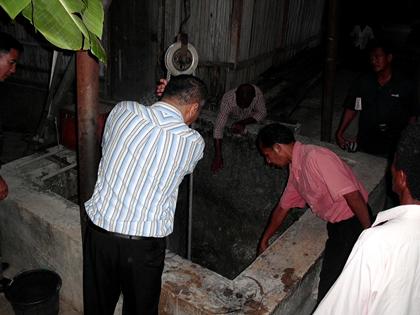
Looking at a precious source of water in arid Timor
Goducate team surveying a corn field

Moringa leaves gram for gram have 4 times the vitamin A of carrots, 7
times the vitamin C of oranges, 4 times the calcium of milk, and 2 times
the protein of milk. Besides these commonly known nutrients, moringa
leaves are also packed with a host of other micronutrients that are
often lacking in the diet of many poor children. The moringa plant can
grow in almost any type of soil (except water-logged soil) and
continues to grow even in long periods of drought. It is therefore
very suitable for NTT and in fact is found growing in many parts of
NTT.

When we did a survey of the community, we found out that the residents
were unaware of the benefits of moringa consumption and seldom ate it
(even if the plant grew in their backyard).

We will be collecting more data about the community’s attitude to consumption and gathering some samples of local moringa seeds for our agricultural experts to assess.

We look to the day when Goducate will be able to help the people of NTT to help themselves with a resource that will thrive in their own backyard.

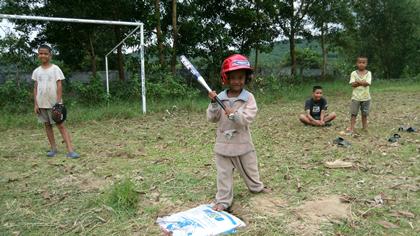
Boys at Goducate Children’s Home in Cambodia learn baseball

Talk about baseball to the kids in the Goducate Children’s Home (and probably elsewhere) in Cambodia and they will simply be disinterested. But show them the gear, teach them the baseball rules, explain the mechanics, let them have their first taste of the game at the diamond field, and they will so awe-struck and excited that they will keep badgering you with their new mantra: “Let’s play ball!”

Two months ago, the US Navy Seventh Fleet gave the Goducate Children’s Home with an assortment of supplies and sports equipment, including some baseball gear. 2 years ago, during the second phase of Cooperation Afloat Readiness and Training (CARAT) in Cambodia, some members of the US Navy, among them, musicians of the Seventh Fleet Orient Band Express, visited the Goducate Children’s Home. They played music with the children and involved them in basketball and soccer games as part of their community service project.

Players in position
Paul gets ready to hit the ball

In Cambodia, however, the national game is soccer, and the youth have not been exposed to baseball. To broaden their knowledge of sports, during my recent visit to the Home, I had a baseball session with the boys. 22 boys, aged 5-17, sgathered at the improvised diamond field for baseball lessons and impromptu practice. Two teams were then constituted at 11 players per team, with 9 in the field—pitcher catcher, 4 infielders, 3 outfielders—and two backup infielders. It was confusing and funny at first but the first tryout and succeeding innings at the diamond field were very instructive and exhilarating for everyone.