Goducate Training Center staff learn from visit to North Sumatra

Three members of staff from the Goducate Training Center in Iloilo, Philippines, were recently in North Sumatra for an exposure trip. Jan, Jet, and Mike were there to learn from Goducate Indonesia, which has partnered with some organizations involved in poverty alleviation. This year, Goducate Indonesia has been in the forefront of helping transform the lives of disadvantaged Indonesians from a state of helplessness into a purposeful one.

In one village, the three observed that most of the people draw income from backyard animal raising, from crop sales, and from being hired workers. The household per capita income is below $800 per year, and the impoverishment is evident from their semi-permanent shelters with palm-frond roofing. The literacy level is low with no-one from among the 120 families in the community having a college degree.

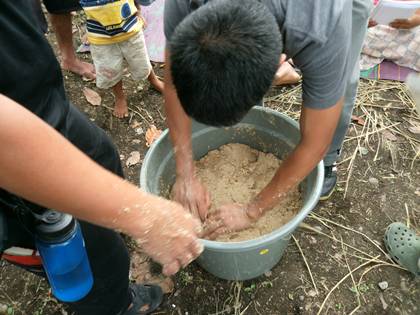
Three months ago, Goducate Indonesia and its local partner conducted a consultation with the people, and the consensus was for a livestock project in the village. At the time the three men from the Goducate Training Center were there, the animal shed was being constructed, so, under my supervision (since I been through farm mechanics, carpentry, and farm structures classes in my days as an agricultural student), they were able to help install the electrical connections, the plumbing, and the electric water pump, thus saving the locals from having to seek expert help from elsewhere. They then showed the locals how to ferment feeds using indigenous materials mixed with proportionate amounts of water and molasses.
One other highlight of their visit was the trip to Nias Island. This is the largest island in a chain that parallels the west coast of North Sumatra. It has a population of about 800,000 people, most of whom are of Malay ancestry. In 2005, the coastal areas were devastated by a tsunami and more than 2,000 casualties were reported. The island used to be famous worldwide as surfing destination but the recent spates of earthquakes have considerably slowed down tourism.

In Nias, the Goducate Training Center staff helped me with my lectures on emerging agriculture technologies and in doing the field surveys. They noted that the islanders are very reliant on income from coconuts and native fruit trees as well as from sea resources. The techniques of food production used there, whether it be from poultry, livestock, vegetables, freshwater fish, grains, or cereals, is low tech, and the emphasis is in meeting the staple needs rather than for commercial scale.

Demonstrating making of fermented feeds
Fixing the electrical line for a livestock project

The feedback from the three Goducate Training Center staff is vital for the enrichment of the existing curriculum at the training center. For instance, they found it worthwhile to include acquisition of basic skills in carpentry, plumbing, electricity, and rapid rural appraisal. These shared ideas will impact a lot on improving instruction so that the students will end up as holistically trained community development workers with the right mind-set of helping needy Asians help themselves.
Goducate agricultural consultant visits Goducate Children’s Home in Cambodia

The main objective of my visit to the Goducate Children’s Home (GCH) in Cambodia was to highlight areas that could contribute to the attainment of food security at the Home. Since Goducate aims to help the needy help themselves, it follows that GCH should be as self-sufficient as possible.

GCH is located 10 degrees north of the equator and sits about 15 meters above sea level. Its total land area is 66,851 sq m. Almost 45 % of the land has food-production potential and 25% is taken up by hardwood/pulp/fruit trees and other species endemic to the area. Small patches are grown with vegetables, corn, dragon fruit, pineapple, and dill.

80% of the land is level or gently sloping. The soil is predominantly sandy silt, highly alkaline, but suitable for fruit and timber trees. The highly porous soil lacks organic matter, which is essential for nutrient and moisture retention. Shallow-rooted plants, such as leafy, fruit, and root vegetables, are able to thrive but yield poorly because practically nothing is applied to improve the soil.

Lowland for conversion into rice production, duck raising, and. pangasius (catfish) culture

GCH has a bull and a heifer as well as seven goats, which graze on a free-range basis. No supplemental feeding is given for balanced nutrition. The poultry consists of 13 turkeys and 28 native chickens, which are also allowed to range freely.

For GCH to attain food security, it must focus on its comparative advantages. One area to consider is additional investments in goats and livestock. Forage grasses grow naturally in the area, so the cut-and-carry combined with forced feeding should be the production system of choice.

The very low organic matter content and fertility of the soil are good arguments for growing high-value vegetables through commercial hydroponics at GCH. In the medium-term, such constraint can be addressed by the application of vermicast and regular spraying of vermitea to the growing plants. This necessitates the sourcing of African Night Crawlers for vermicomposting. Morninga should be extensively planted to provide a source of nutritious Moringa-based foods and tea, and for animal feeds.

Also essential at GCH is a nursery for raising good-quality seedlings. The Home might even consider getting high-quality coffee and cacao seeds to turn the idle 1.15-hectare eastside idle space into an industrial plantation. The one-hectare remnant lowland, on the other hand, can be proportionately partitioned into parcels for rice production, duck raising, and catfish rearing.

Eroded soil with low organic matter content

The children at the GCH are already picking up agricultural and technical skills informally through their daily duties. A workshop has recently been built at GCH to train the children more systematically in technical skills. More systematic training in agricultural skills could also be considered. Two of the children from GCH are at present undergoing intensive training at the Goducate Training Center in Iloilo, The Philippines, to be community development workers. With good vocational training at GCH, more can be trained locally to be effective agents of change when they return to their respective communities.

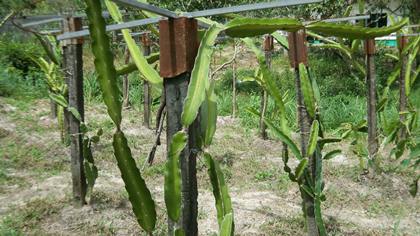
A patch of dragon fruit plants

Secret of “humongous” crops at Goducate Training Center is in vermitea

Many people think that the humongous plant cultivars with upsized leaves, fruits, tubers, bulbs, heads, rhizomes, and grains that taste delicious grown at the Goducate Training Center are a result of application of commercial fertilizers, or maybe of abundant sunshine. Or maybe even of the use of synthetic hormones. The secret, though, is in the use of the vermitea that we brew and apply to plants by soil drenching or foliar spraying.

African Night Crawlers
Vermitea brewer
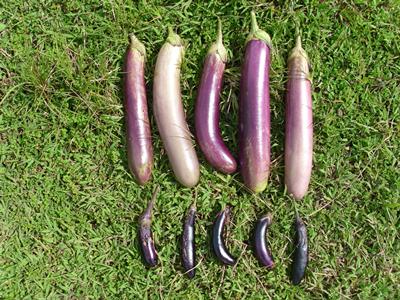
Eggplants with vermitea (upper row) and without vermitea (lower row)

To produce vermitea, earthworm casting (excrement) or vermicast is needed. At Goducate Training Center, we raise African Night Crawlers in pre-composted livestock manure mixed with rice straw and shredded leaves and twigs of leguminous plants. The vermicast is then brewed with chlorine-free water and molasses for 72 hours. The resultant vermitea should have a pleasant, earthy smell. If it smells awful, it indicates that bad microbes have overwhelmed the population of good microbes, and thus should be discarded.

The vermitea can be mixed with plain water in various concentrations. As much as 300 liters of sprayable material can be produced from only 1 kg of vermicast. The vermitea is applied within 8 hours from harvesting to maintain the potency of the aqueous extract. It should be applied once a week but we have found that spraying 2-3 times a week produces dramatic results.

Okra leaves without vermitea (left) and with vermitea (right)

Vermitea teems with microorganisms that include bacteria, fungi, protozoa, and non-harmful nematodes. They build a good microbial community in the soil and, over time, outnumber the bad microbes. They protect the roots as well as nourish and feed the plant. Roots penetrate wider and deeper. Unlike vermicast that takes days to mineralize and become available for root uptake, vermitea is readily absorbable when applied as a foliar spray. The microbes also attach themselves to the leaves and overcome the pathogens that cause mildew, black rot, and early blight. Vermitea also suppresses several other plant diseases as well as populations of spider mites (Tetranychus urticae), aphids (Myzus persicae), and plant parasitic worms that cause root cysts on tomatoes.

Our experience with vermitea has reflected research that has shown how vermitea has increased the germination, growth, flowering, and yields of various crops. We hope that we can pass this experience on to the needy to help them help themselves.