Goducate Training Center staff undergo sports training

A 3-day mini sports course was held at the Goducate Training Center (GTC) in Iloilo, The Philippines, for staff of the center during the break that the GTC trainees were having. Those GTC trainees who stayed on at the center during their break also took part in the course. In addition, the mini course was open to community leaders. Altogether some 60 people took part in the course, which was divided into three parts—basketball, basketball refereeing, and lifeguard training. Training was conducted by Goducate sports director Boycie Zamar, George Magsino (an international basketball referee) and Jojo Rivera (a licensed basketball and swimming coach and a licensed lifeguard).

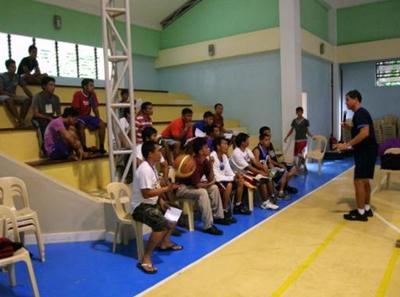
George Magsino lecturing on the theory of basketbal refereeing
Lifeguard participants preparing for actual pool rescue

These skills are useful for community development workers, so the first step is to train our staff in them. Basketball is a good way of engaging the communities we work with and instilling in them qualities such as discipline, teamwork, leadership etc. Basketball refereeing offers people, including our community development workers, a means of livelihood. Likewise, lifeguard training. Besides, there is a pool at GTC, so it is essential for GTC to have lifeguards on site.

Participants chose which of the three skills they wanted to learn. In the three days they could be trained only to basic level. Training at higher levels will be offered soon.

After the course, we received numerous requests for similar coaching to be held elsewhere, which we will be considering.

Presentation of certificates

Secret of “humongous” crops at Goducate Training Center is in vermitea

Many people think that the humongous plant cultivars with upsized leaves, fruits, tubers, bulbs, heads, rhizomes, and grains that taste delicious grown at the Goducate Training Center are a result of application of commercial fertilizers, or maybe of abundant sunshine. Or maybe even of the use of synthetic hormones. The secret, though, is in the use of the vermitea that we brew and apply to plants by soil drenching or foliar spraying.

African Night Crawlers
Vermitea brewer
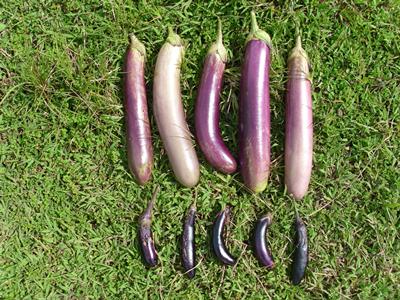
Eggplants with vermitea (upper row) and without vermitea (lower row)

To produce vermitea, earthworm casting (excrement) or vermicast is needed. At Goducate Training Center, we raise African Night Crawlers in pre-composted livestock manure mixed with rice straw and shredded leaves and twigs of leguminous plants. The vermicast is then brewed with chlorine-free water and molasses for 72 hours. The resultant vermitea should have a pleasant, earthy smell. If it smells awful, it indicates that bad microbes have overwhelmed the population of good microbes, and thus should be discarded.

The vermitea can be mixed with plain water in various concentrations. As much as 300 liters of sprayable material can be produced from only 1 kg of vermicast. The vermitea is applied within 8 hours from harvesting to maintain the potency of the aqueous extract. It should be applied once a week but we have found that spraying 2-3 times a week produces dramatic results.

Okra leaves without vermitea (left) and with vermitea (right)

Vermitea teems with microorganisms that include bacteria, fungi, protozoa, and non-harmful nematodes. They build a good microbial community in the soil and, over time, outnumber the bad microbes. They protect the roots as well as nourish and feed the plant. Roots penetrate wider and deeper. Unlike vermicast that takes days to mineralize and become available for root uptake, vermitea is readily absorbable when applied as a foliar spray. The microbes also attach themselves to the leaves and overcome the pathogens that cause mildew, black rot, and early blight. Vermitea also suppresses several other plant diseases as well as populations of spider mites (Tetranychus urticae), aphids (Myzus persicae), and plant parasitic worms that cause root cysts on tomatoes.

Our experience with vermitea has reflected research that has shown how vermitea has increased the germination, growth, flowering, and yields of various crops. We hope that we can pass this experience on to the needy to help them help themselves.

Goducate trainees finish first module of their course

On May 25 the Goducate Training Center celebrated the completion of the first training module taken by its first batch of full-time trainee community development worker (CDW).

These 33 trainees, from Philippines, Cambodia, Indonesia and China, had
undergone a rigorous 2-month program in agriculture, teaching methods, literacy teaching, counseling, etc. Before they took a well-deserved one-week break before returning to finish the remaining 6 months of their course, they presented a Culminating Program to showcase what they had learnt.

The guests included officials from San Miguel town (the town in which GTC is situated), parents of the trainees, and supporters of Goducate.

To me the highlight of their presentation was the ability of the trainees to work across cultures, to produce creative items, and to express themselves articulately. The master of ceremonies for the day was an Indonesian trainee who spoke confidently in English. Having known him before he came to GTC, I was amazed how much had changed in a mere 2 months. The Chinese and Cambodian trainees also comfortably fitted into their English-speaking roles. Filipino trainees spoke in accent-perfect (almost!) Mandarin and Khmer (Cambodian) in preparation for future work in China and Cambodia.

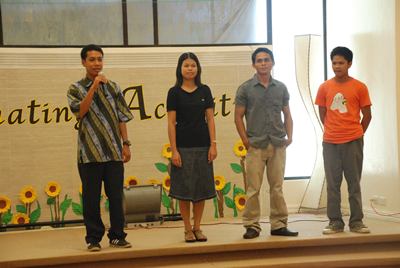
Trainees speaking in second language

After watching them, I was confident that they had the potential to be effective CDWs — who could enter needy communities to help them to help themselves.

A choir